
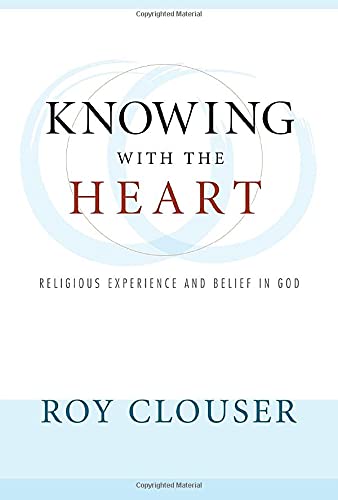
Knowing with the heart: Religious Experience and Belief in God
Written by Roy Clouser Reviewed By Patrick RichmondThe famous scientist and philosopher Pascal memorably said ‘the heart has its reasons the mind will never know’. By the heart’s ‘reasons’, Pascal meant, not emotions, but our intuitive knowledge of ‘the first principles of number, time, space, and motion’. He believed that God is known in a similar way. Clouser develops Pascal’s position: the traditional arguments for God’s existence don’t work, but belief in God doesn’t require proof. All but the third chapter take the form of an imaginary dialogue with an unbeliever and, unlike some such dialogues, the sceptic seems to voice most of the obvious objections. Clouser urges unbelievers to ask God to reveal himself if he exists. They should undertake an open-minded study of the Bible with the aid of a Bible Dictionary and in close association with Christian believers.
Much of the first chapter tries to define a religious belief, delaying discussion of the main thesis. Clouser contends that religious beliefs concern what is unconditionally, independently real. Unfortunately, this definition seems to fit neither normal usage nor religions like Buddhism that avoid metaphysical beliefs. Clouser wants to argue that positions like naturalistic materialism are intuited rather than proved, just like Christianity. His second chapter also delays discussion of the main thesis as he discusses types of religious belief and experience. Clouser defines a religious experience as one directly producing a certain belief in unconditional reality. Such belief can be counted both faith and knowledge. The experience need not be unusual or discrete.
The third chapter contains the heart of the argument that religious belief can be entirely justified without proof or argument. Not everything can be proved; there must be some starting axioms or premises. Most philosophers have allowed beliefs justified by what is evident to the senses or self-evident. Clouser takes self-evident beliefs to be certain without being inferred from any other beliefs; they are apprehended by intuition. This apprehension need not be instant and is not infallible. Intuition can be over-ridden by other self-evident beliefs. Even mathematical axioms are sometimes disputed and Hindus and Buddhists report experiences that seem to override even logic and sense perception.
The fourth chapter compares belief in God to belief in the axiom of equals, the axiom that two things equal to a third thing equal each other. The doctrine that belief in God can be intuitively certain was held by Augustine, Luther, Calvin and Pascal. People may reasonably reject arguments disproving what seems self-evident, even if they cannot tell what is wrong with them. Religious beliefs are not completely determined by culture, and all beliefs are subject to some cultural conditioning. For example one South African culture only has words for counting to three, making mathematical axioms harder to grasp! Various experiences can confirm belief in God, just as they do other self-evident beliefs.
In the final two chapters, Clouser tackles objections, such as that Scripture is unreliable, contradicts modern science, and is falsified by the existence of evil. Clouser is well aware that these are all huge questions but offers many helpful comments. Unfortunately, he also offers some contentious claims without any support. In relation to evil, Clouser claims that God need not be loving or just. He has decided to be good in the ways that he has promised, and no more. Arguably, this leaves God less good than he might have been and so unworthy of unconditional worship and devotion. Arguing that we cannot expect to know God’s good reasons for evil might have been a better strategy.
Overall, Clouser downplays the power of argument to change minds, both in philosophy and especially in religion, and seems more willing to accept justified stalemates in religious argument than many. However, the main argument, when it comes, is important, cogent and clear, even to those with little grounding in philosophy, and should be considered by all those interested in apologetics and philosophy of religion.
Patrick Richmond
St Catharine’s College
Other Articles in this Issue
Other Reviews in this Issue
Justice that Restores
Reviewed by Dewi Hughes