
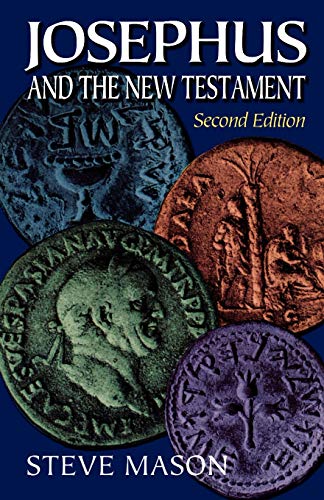
This interesting and affordable book offers an assortment of material on Josephus’s life and writings in relation to the NT. Since the author has recently published a major scholarly study on Josephus’s description of the Pharisees, he is well placed to write an introduction such as this. It has helpful and up-to-date bibliographies of ‘additional reading’ after each chapter and is generally clear and readable. There are interesting discussions of personalities and groups mentioned in both Josephus and the NT. The third chapter in particular contains extremely useful surveys of the main themes, purposes and content of the writings of Josephus within the context of Greco-Roman perceptions of the Jews. This is very helpful and stimulating material which genuinely helps to ‘understand Josephus on his own terms’. At times, however, Mason defends idiosyncratic and minority positions which, while arguable, make this less than ideal as an introductory textbook. Two examples are worthy of discussion.
Firstly, in his discussion of the career of Josephus (ch. 2), Mason follows the general principle that ‘ancient writing was so completely given over to persuasion, or “rhetoric”, that no author from that time should be taken at face value’. This leads to a reductionist approach which minimizes the historical value of those elements in the early portions of Josephus’s Life that have a rhetorical function. The famous passage in which Josephus claims to have experienced life among the Pharisees, Sadducees and Essenes is, like his claim to a priestly genealogy, criticized on the grounds that ‘it is brimming with rhetorical commonplaces’. In other words, because it was a standard ploy to introduce one’s work with a claim to a broad philosophical training this cannot be taken seriously as history.
One wonders how Glenna, Cara and Ian feel about all this. Mason dedicates tire book to them, describing them as ‘the joys of my life’, but we all know that such dedications are merely a common rhetorical device and cannot be taken at face value. Mason’s principle is misplaced. Linguistic communication depends entirely on conventional associations, and rhetorical forms in particular become conventional because they are found to be useful and appropriate by a substantial number of writers. The claims made may need to be tested (like Mason’s claim to teach at Vanier College), but cannot be dismissed on ‘rhetorical’ grounds alone. When Mason is forced to acknowledge from the writings of Josephus that he ‘knew a good deal about the Pharisees, Sadducees, and Essenes’, this should be taken to support Josephus’s claims as accurate (note that Mason does not agree with the consensus view that Josephus was a Pharisee himself).
Secondly, Mason puts together an argument for Luke’s (at least, ‘the author of Luke-Acts’) knowledge of Josephus’s works (and thus a date after ad 95 is most likely for the writing of Luke-Acts). This argument is based on various similarities between the two sets of writings: both are Hellenistic histories heavily influenced by the OT, both use conventional prefaces written for a dignitary of some sort. Both authors use key speeches to present characters and develop their plot. Both report a certain (fairly limited) number of events in common, including Quirinius’s Census, Judas the Galilean, Theudas, the Egyptian Prophet. Both use some similar vocabulary. Mason argues that Luke’s narrative seems to depend upon information supplied by Josephus, even when Luke clearly disagrees with that information. Mason is not the first to argue that ‘Luke’ knew Josephus, and he probably won’t be the last, but he is the most recent. The argument is not, however, particularly compelling, unless one assumes to begin with that ‘Luke’ had no independent access to historical information concerning the events he writes about (against Lk. 1:1–4).
In conclusion, then, this is a stimulating and informative book from which much can be learnt about Josephus and his writings. Mason forces the reader to encounter Josephus on his own terms, as a purposeful writer with complex motives rather than as the compiler of a historical and geographical compendium. The book is less helpful on the NT than I would have liked in an introductory textbook, which is somewhat unfortunate given the rhetorical claims made for the book.
Peter M. Head
Peter M. Head
Tyndale House
Cambridge, England, UK
Other Articles in this Issue
Other Reviews in this Issue
Gnosticism and the New Testament
Reviewed by Stanley E. Porter