
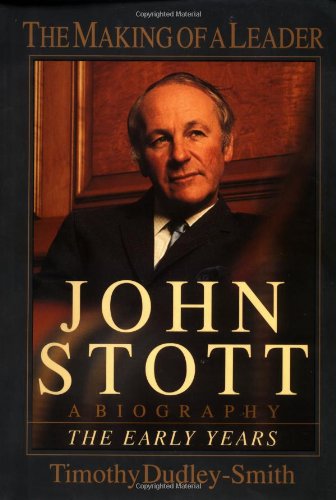
The reviewer read this major biography on flights to and from an event in Korea at which John Stott was speaking last summer—the quadrennial World Assembly of the International Fellowship of Evangelical Students.
So much about him in this life story appears to quintessentially English: the social context, the public school education, the Anglican ministry, and much more. Yet there he was in Asia, among delegates of 134 countries from every corner of the world: he was not only thoroughly at home, but had obviously captured the hearts and engaged the minds of people from totally different cultural backgrounds. The near-octogenarian with his taut, precise, no-wasted-word delivery, was in sharp contrast to other styles on offer, yet he clearly communicated with those in their twenties and was affectionately known as ‘Uncle John’ or even ‘Papa John’ (no papal reference intended). His worldwide influence was apparent.
This unrushing book tells the story of the first 40 years of his life. It is beautifully written, as is to be expected from one whose hymns are so clear and expressive, so full of truth as well as feeling.
The story covers a period of great change and much growth in the evangelical world.
At the lime of his ordination in 1945 it was difficult to see a future for evangelicalism, in the Church of England at least, as anything more than a faithful remnant, marginalised and all but excluded … (9).
The book tells how, from small beginnings, John Stott began to ‘pursue his vision of a church apostolic in faith, alive in the Spirit, taught by the Scriptures and ready to respond in mission’ (10).
Before it comes to that wider scene, however, it leads us through his home background and schooling. His father, Arnold, a Harley Street consultant physician (as a cardiologist) held intellectually to ‘scientific secularism’. They went to the (local) All Souls, Langham Place—Arnold two or three times a year, his mother Lilly fairly regularly. They were there for 15 years under a ‘liberal evangelical’ ministry, though Lily, with a Lutheran background, taught John and his older sisters to read the Bible and ‘say our prayers’. The leading ideas of the world in which John Stott grew up were expressed in the year of his birth (1921) by the Regius Professor of Divinity at Cambridge: ‘The new physical sciences have rendered untenable the traditional ideas of authority, of the supernatural, of miracles, and in fact of the whole method of God’s operation’ (37).
Arnold wanted his son to go to his old school, Rugby, so sent him first to a ‘prep school’ (where his love of birds started). At Rugby a boy a year senior to him invited him to the ‘Christian Union’, to which came as a speaker E.J.H. Nash (‘Bash’), who ran camps for boys from public schools. It was through Bash that he came to faith and Bash’s encouragement had a profound effect on his whole life and direction.
He went up to Cambridge in October 1939, when fewer than 2% of 18 year-olds went to university. He never joined the Christian Union, but only because of a promise he made to his father (who said: ‘Don’t join it: a lot of anaemic wets’). However, he went to most of its meetings and wrote (in 1989): ‘I sometimes wonder on what particular scrapheap I would be today, if it had not been for God’s providential gift of the UCCF … the CU brought me friendships, teaching, books and opportunities for service, which all helped me to stand firm and grow up. I am deeply grateful’ (128).
His personal godliness and devotion shine out all through his life, inspired and fed by his discplined habits of prayer and Bible study. His attitudes were always self-effacing, wanting always to point people to Christ and his word.
He moved towards ordination and pacifism, both to the chagrin of his father. Arnold, who served in the First and Second World Wars, had hoped that his son would enter the diplomatic service. The biographer paints an agonising picture of the rift that these decisions brought between them. ‘The buried scars of their wartime differences [meant that] the bright, confident morning of their early years was never to be quite recaptured’ (192). ‘For about two years he found it virtually impossible to speak to me’ (162).
When John Stott read theology in preparation for the ministry, he found himself (amid the prevailing liberalism) ‘the only person who did not agree with C.H. Dodd’s lectures (183). He showed the courage of his convictions, which were strengthened by Douglas Johnson (first General Secretary of the IVF/UCCF) and Oliver Barclay (who overlapped at Cambridge and later was UCCF’s second General Secretary). He also derived great benefit from meetings at the newly-established Tyndale House (202).
The story then covers his early days as Assistant Curate at All Souls, some early contacts with Martyn Lloyd-Jones, his long period as Rector of All Souls and his clear strategy for evangelism there. It then moves on to ‘a wider vision’—his role in university missions (the first of many all over the world was at Cambridge in 1952), the Billy Graham Crusades, his ‘Eclectic Society’ and many other initiatives inside and beyond Anglicanism. It also covers personal issues—how, for example, he entered the 1950s expecting to become a husband and had to come to terms with ongoing bachelordom. In that connection, some friends once drew his attention to the frenzied activity of a pair of Manx Shearwaters and asked if they were mating or fighting. ‘I understand there’s not much difference’, was the reply.
The book, like the first volume of Iain Murray’s biography of Martyn Lloyd-Jones covering roughly the same period, is essential reading for those wishing to understand the influences that moulded so much of evangelical life today. While it does not analyse all that it describes (for example, it does not enter the debate, hot at the time, about Billy Graham’s ‘decisionism’), it does provide the basic material for such analysis.
It is a thought-provoking, fascinating and moving account of an outstanding servant of God and his church. We eagerly await the second volume.
Bob Horn
Cranleigh, Surrey
Other Articles in this Issue
Other Reviews in this Issue


Don’t Muzzle the Ox
Reviewed by Steven Singleton