
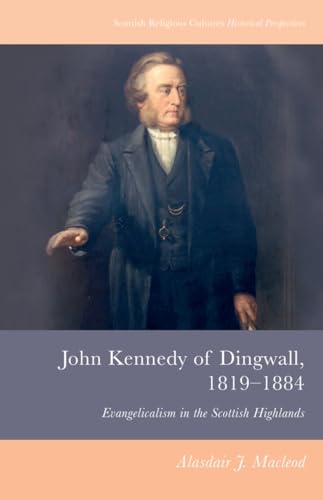
John Kennedy of Dingwall 1819–1884: Evangelicalism in the Scottish Highlands
Written by Alasdair J. Macleod Reviewed By Kenneth J. StewartIn his time, John Kennedy of Dingwall was a celebrated preacher of the Free Church of Scotland, a man so fluent in both English and Gaelic (the language of the north and west of Scotland) that his preaching was thronged in his own community of Dingwall as well as beyond. He counted C. H. Spurgeon (1834–1892) as a personal friend, with the London Baptist preacher filling his Scottish pulpit on one notable occasion. Kennedy’s stature was such that the regional railway made a private railway car available to him as he traveled distances to preach. Yet this earnest preacher, renowned in his lifetime, is almost unknown outside his region today. A biography, composed soon after his 1884 passing by Alexander Auld (1887), has stood alone in book-length treatments.
But it is not just the accumulated neglect of almost a century and a half that has motivated Alasdair Macleod, now of Highland Theological College, Dingwall, to re-appraise this Christian stalwart. John Kennedy of Dingwall deserves fresh attention because he was as closely associated with the fragmentation of Scottish cultural and religious life in the face of change as was any Scot in the second half of the nineteenth century. While the reader of this review may think this is a very odd honor to bestow on Kennedy, it needs to be grasped that the controversies in which he involved himself, controversies contributing to the fragmentation just named, were controversies in which Themelios readers themselves have a stake.
The question was then and is now, “How, if at all, can the evangelical Reformed faith adapt to marked attitudinal change in society?” Macleod’s “Introduction” hints at what is to come: “If John Kennedy began his ministry in 1843 as a mainstream Free Churchman, he ended it at his death in 1884 as a perceived hardliner and conservative, a leader in the so-called ‘Constitutionalist’ party that included the majority of the Highland Free Church” (p. 1).
Macleod, who has taken pains to research his subject at the level of cultural as well as theological history, acknowledges that the customary distinction of Scotland, geographically and culturally, into Lowlands and Highlands has been somewhat fluid across the centuries. The Highlands waited the longest to embrace the Protestant Reformation; the same region was the center of loyalty to the dethroned Stuart monarchy in the rebellions of 1715 and 1743. Yet the eighteenth century was also when earnest evangelical Protestantism took root in the region. Kennedy knew this and sought to conserve this cultural and religious past. The Lowlands, by contrast, were the first to industrialize and had a greater affinity to the language and culture of England. Religious trends from England and America found their way into the Lowlands most readily.
John Kennedy’s culturally and theologically conservative stance tended to magnify this cultural divide; before long, opponents within his denomination referred to his largely northern supporters as the “Highland Host.”
By the 1860s, Kennedy (who reckoned himself a reluctant controversialist) began to be drawn into debates about the terms on which his denomination (the Free Church of Scotland) might unite with other Presbyterian bodies that also existed outside the established Church of Scotland. With sympathizers (by no means only Highlanders), he was adamant that there could be no union with denominations that abandoned full allegiance to the Westminster Confession and Catechisms; several Presbyterian denominations had by then retreated from that full loyalty. Kennedy’s “confessionalist” insistence on strict subscription prevailed, but only for the near term. Soon, he was also a vocal opponent of Sunday railway traffic.
In the years following, Kennedy found himself in a minority (increasingly made up of fellow Highlanders) in opposing the introduction of hymns into worship and, subsequently, keyboard instruments. Yet public taste had markedly shifted in favor of musical change. The evangelistic tours to England and Scotland of D. L. Moody and the vocalist, Ira Sankey, provoked additional protests. On the one hand, Moody and Sankey inflamed the already-existing debate about sung praise with their introduction of gospel songs emphasizing the joy of conversion and the experience of the Christian life. Kennedy perceived (correctly) that the focus of this new sung praise was not, in the first instance, our Savior God. On the other hand, Kennedy protested in Moody what he perceived to be a de-emphasis on repentance and an under-emphasis upon the sinner’s need to turn to Christ, in place of which had been substituted an idea of mere acceptance of gospel facts as true. In this controversy, Kennedy found himself at odds with some (like the renowned Bonar brothers, Andrew and Horatius) who had earlier been Kennedy’s allies in defending strict confessional conformity.
His Free Church of Scotland, having existed virtually as a voluntary denomination for decades since its 1843 withdrawal from the established Church of Scotland, came increasingly to see that its continued insistence on state recognition and support had become an impediment. The hypothetical claim now seemed to obstruct collaboration and reunion with other denominations that opposed the very notion of state connection. With the Free Church now wavering on this point, Kennedy did not. As a Highlander, he perceived that the Free Church in the north was functioning as the “de facto” majority Protestant church. Was this religious dominance not worthy of state recognition? With the passing of each decade, Kennedy was becoming deservedly known as a contrarian, making strong defenses in support of losing causes.
A similar script unfolded in the 1870s battle over the entry of German higher criticism into the Free Church’s theological colleges. Kennedy and his numerous allies wanted to see the prime offender, William Robertson Smith, found guilty of heresy. In the end, they had to settle for mere inquiries and the removal of the professor from his post without any clear repudiation of error. Higher criticism’s right to exist was implicitly confirmed.
This was the terrain in the Free Church of Scotland at Kennedy’s passing in 1884. Like-minded followers upheld his concerns, some withdrawing from the Free Church of Scotland in 1893 (to form the Free Presbyterian Church), still others declining to enter an enlarged United Free Church of Scotland in 1900. Weary of the relaxed doctrinal standards endorsed by the two churches uniting in 1900, that small non-concurring group continued as today’s Free Church of Scotland.
Modern readers will easily find things to admire in John Kennedy. Here was a man tenacious in his convictions, a man who was motivated with great zeal for God’s truth. At the same time, few readers will endorse every stance he took on the controversies named. Making no apology for theological error, one may still observe that Kennedy lacked a sense of the organic development of Christian teaching. Such development requires a painstaking re-statement of the Christian faith in changed times.
In the generation to follow, fellow Scot, James Orr (d. 1913) wrestled with this reality in his The Progress of Dogma (1903), while across the North Sea, Herman Bavinck (1854–1922) would compose a fresh Reformed Dogmatics (1895–1901) in the face of a newly-secularized Europe. Kennedy showed no preparedness for orthodox consideration of emerging questions brought on by social and intellectual change. Instead, he reiterated past orthodoxies: trains ought not to run on Sundays; mass evangelism is ill-conceived; only the Psalms are fit to be sung by Christians; instrumental music—being part of Old Testament ceremonial—has no place in Christian assemblies; any biblical criticism beyond textual criticism is suspect. A Christian faithfulness that fails to go beyond reiteration can leave us utterly disconnected from the changed societies in which we are called to live and minister.
We are the debtors of Alasdair Macleod for his sensitive and nuanced probing of Kennedy, the man whose well-intentioned efforts to defend Reformed orthodoxy unwittingly advanced marginalization.
Kenneth J. Stewart
Ken Stewart is emeritus professor of theological studies at Covenant College in Lookout Mountain, Georgia.
Other Articles in this Issue
The Spirit of God and the Religions of the World: A Response to Amos Yong’s Claims
by J. David WilloughbyAmos Yong, an acclaimed Pentecostal scholar, argues for what he calls a pneumatological theology of religions...
Pastoral Pensées: “We Do Not Lose Heart”: Theological Encouragement for Endurance and Opportunities for Reflection from 2 Corinthians 4:1–16
by Cody WilbanksBurnout is an evergreen threat for those in Christian ministry...
Contraception and the Church: Making Sense of the Debate and Some Pastoral Advice
by Dennis M. SullivanThis article reviews the ethical and theological issues surrounding birth control, with an emphasis on hormonal methods...
“Union” has become an increasingly valuable tool in discussions of atonement and soteriology...
Other Reviews in this Issue