
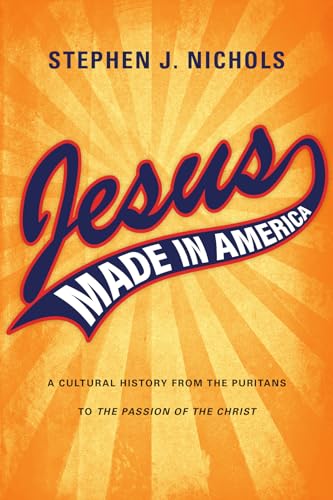
Jesus Made in America: A Cultural History from the Puritans to the Passion of the Christ
Written by Stephen J. Nichols Reviewed By Jeffrey RobinsonWhile driving to my office at Southern Seminary the other day, three bumper stickers caught my attention. One was adorned with a peace symbol and read, “Jesus was a liberal.” A second was black with green letters made to look like spray-painted graffiti and read, “Jesus is my homeboy.” A third obviously was adorned with the Promise Keepers logo and read, “Real Men Love Jesus.” Three vehicles, three bumper stickers, and three different messages about Jesus.
It seems that Jesus is on the minds of an unprecedented number of people in the West today, and Stephen Nichols, research professor of Christianity and Culture at Lancaster Bible College in Lancaster, Pennsylvania, takes note of the trend of popularizing our Lord and traces its development in Jesus Made in America.
Nichols argues what the bumper-sticker culture seems to confirm: in the United States, Jesus has become as uniquely a part of the American brand as baseball, hot dogs, apple pie, and the stars and stripes. The Jesus that has emerged in twenty-first-century America, however, barely resembles the Incarnate Son of God, the second Person of the Godhead who emerges from Scripture, the Lord who was worshiped by our Puritan forbears.
Nichols accomplishes his task by unfolding the way in which Jesus was perceived and expressed in the popular culture throughout American history. His journey with Jesus begins with the founding fathers of our democracy; Thomas Jefferson crafted his own Jesus by taking a pair of scissors and literally snipping away the offensive parts of the New Testament, parts that made Jesus appear unloving according to Jefferson’s sentimental definition of love. As Nichols puts it, the Jesus who survives Jefferson’s cutting exercise as well as the Jeffersonian era was a Jesus who “is a fine purveyor of morality and virtue. He is humble and meek, industrious and honest.” In the popular mind, the four Gospels were seen as a fine guide to private devotion and piety.
Next, Nichols walks with Jesus through his Victorian makeover period; here Jesus becomes meek and mild, the friend of children. This version of Jesus met his match later, however, in the late-19th and early-20th century when two basic manifestations emerged: the “good man” of liberal pastor Harry Emerson Fosdick and the “man’s man” of Billy Sunday. J. Gresham Machen emerged onto the scene and called for a recovery of the Puritan and biblical Jesus.
Nichols then traces Jesus in his various American modes during the twentieth century: Jesus as the peace-loving man of the Jesus People, Jesus the big-screen draw of Hollywood motion pictures, and the consumerist Jesus of the Madonna videos and the “WWJD?” Movement. Finally, Nichols concludes by showing how Jesus has been politicized by quasi-evangelical groups such as the Moral Majority and the Republican Party.
All in all, Nichols clearly and vigorously defends his thesis. He provides overwhelming anecdotal documentation of the way in which Jesus has been commandeered by the changing cultures of America. The work compellingly argues that the Jesus who has arrived on the American stage in twenty-first century America is sadly a Jesus who is foreign to the New Testament Gospels, a Jesus who would scarcely be recognized by Jonathan Edwards and those of his theological tradition.
As with all of Nichols’s works, Jesus Made in America is written in a lively style, one from which the author’s voice clearly and uniquely rings. His case is compelling and his argument is one that needs to receive a wide reading in evangelical churches. May Nichols’s work cause evangelicals to rediscover the robust Jesus of Holy Scripture.
Jeffrey Robinson
The Southern Baptist Theological Seminary
Louisville, Kentucky, USA
Other Articles in this Issue
Though his primary concern was how to persuade people from diverse backgrounds to embrace the gospel of Jesus Christ (1 Cor 9:12, 23), Paul, nonetheless, embodies a principle common to all who would provide leadership to a community comprised of a multiplicitous collection of rigid truth claims and behaviors...
The Ethnic Enemy—No Greek or Jew . . . Barbarian, Scythian: The Gospel and Ethnic Difference
by Keith FerdinandoWhatever 'globalisation' may be, it has been accompanied by insistent and sometimes violent affirmations of ethnic identity...
Despite a small flurry of attention over the past decade, Adolf Schlatter (1852–1938), Tübingen professor of New Testament and author of more than 440 written works, remains one of the most neglected yet illuminating theological voices of the past one hundred years...
Commentators have customarily interpreted Phil 2:12 as a reference to "working out" one's personal salvation...
Salvation History, Chronology, and Crisis:1 A Problem with Inclusivist Theology of Religions, Part 1
by Adam SparksA fundamental requirement in an inclusivist understanding of the relationship between Christianity and other religions is evidence of God's salvific activity outside of any knowledge of Christ...
Other Reviews in this Issue