
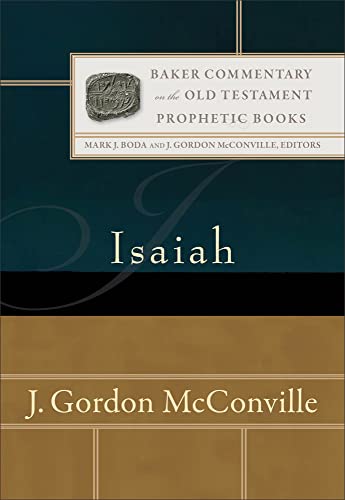
The book of Isaiah has been the favorite OT prophetic book for many believers from the beginning of the church, both because of its witness to Jesus Christ and because of its images of hope and salvation associated with Zion. This commentary by respected scholar J. Gordon McConville is published in the BCOT series on prophetic books, which aims to pay “particular attention to … their rhetorical strategies and their relationship to history” (p. viii). This commentary provides a rare combination of clarity, erudition, and helpful theological insights, making it a highly recommended volume.
The commentaries in this series are intended for “serious students of the Bible, including those who wish to draw on good biblical scholarship for the purpose of teaching or preaching” (p. ix). Therefore, while they have some use for scholars and researchers and are occasionally useful for application, the real goal for each commentary is to be a substantial resource for readers who seek a deeper understanding of Scripture. Each commentary usually contains brief theological reflections at the end of each chapter and the series casts “an eye toward contemporary concerns” (p. ix). Moreover, the editors (Mark Boda and McConville) “hope to highlight the distinctive contribution of each prophetic book and its relationship to other parts of the canon.”
The introduction (pp. 1–17) covers the book of Isaiah’s scope, relation to history, structure, authorship, theology, language, form, translation, text, and the conventions of the commentary. These discussions come from a top scholar with a gift for clarity, though it is obvious that due to brevity there cannot be much depth. For instance, historical context spans less than two pages, authorship four pages, the text one page, and theology less than two pages. The brief section on theology is likely due to the theological reflections found at the end of each of the commentary’s sixty-four chapters.
The commentary is divided into six major parts, following the generally agreed structure of the book: 1:1–12:6; 13:1–27:13; 28:1–35:10; 36:1–39:8; 40:1–55:13; and 56:1–66:24. Every major section has an introduction, usually less than a page but still very useful. There is no concluding section or chapter to the book, but the author provides a useful bibliography, a subject index, an author index, and an index of Scripture and other ancient writings.
McConville does not believe that Isaiah, the son of Amoz, is behind the entire book of Isaiah. He takes “the more usual modern view that the book was composed over a relatively long period and completed much later than Isaiah’s own lifetime” (p. 8). However, out of respect for the authors who hold the more traditional view (e.g., Alec Motyer, John Oswalt, Barry Webb), he offers a brief defense of his position (pp. 8–12). It is highly doubtful that the brief and somewhat confusing defense of his understanding will change anyone’s position on this issue.
The greatest strengths of this commentary are very much in line with the goals of the series. McConville provides consistently useful exegetical insights, draws on the best of biblical scholarship, is a wise guide through the many options that confront the readers, provides sensible theological reflections, and engages skillfully with implications in Christ and the New Testament (e.g., pp. 115–16, 189, 330–31, 401, 459, 604, 614). Additionally, the author constantly makes insightful biblical connections (e.g., pp. 458–459, 498, 613, 632), and frequently uses his knowledge of the ancient Near East to illuminate the text (e.g., pp. 106, 150, 294, 462, 613). I also found very useful his habit of providing summaries and leading ideas (e.g., p. 715), and his comments on the Messianic hope (e.g., pp. 147, 150, 715).
Based on the goals of the series, it is not possible to speak about “weaknesses” in connection with this volume. However, I found myself occasionally wishing that some passages or translations were explained a bit more fully. For example, I would have appreciated further discussion about divine sovereignty and human responsibility on Isaiah 6:9–10 (p. 110), the statements about the servant’s justification/rectification (p. 567), or the translation of אנשי לצון as “cynics” in Isaiah 28:14 (pp. 324–25).
McConville does an excellent job pointing out the significance of Isaiah 1:2–4 (the rebellion of children/Israel against their Father/God) as “the problem to which the book as a whole is a response” (p. 22). Moreover, he describes very powerfully the fatherhood of YHWH and the unnaturalness of his children’s rebellion, noting that “the rebellion sounded in these opening lines of the book of Isaiah returns in its very last verse (Isa 66:24) and thus frames the whole prophecy” (p. 26). While this is very helpful and true, one wishes that this key theme of rebellion was addressed again when expounding Isaiah 66 (especially verse 24). A concluding emphasis on the problem of rebellion and how this is dealt with by YHWH throughout the book would have improved this commentary. Nonetheless, these are minor quibbles, reasonably explained by the goals of the volume and the limits of space.
McConville is a world-class scholar on Deuteronomy and the Prophets at the height of his craft. He has clearly put much judicious effort into writing this volume, so it is no surprise that the resulting work fulfills the goals of the series with a significant new commentary on Isaiah. It is a gift to any serious student of this monumental, complex, theologically challenging, and inspiring prophetic book as it deals very well with the ancient text in its original context and has relevant comments for believers today. The rare combination in this commentary of clarity, erudition, and theological insights makes it a highly recommended volume and a mainstay for the serious student along with the earlier works of John Oswalt (NICOT and NIVAC) and Alec Motyer (IVP).
Cristian G. Rata
Cristian G. Rata
Training Leaders International
Minneapolis, Minnesota, USA
Other Articles in this Issue
The Spirit of God and the Religions of the World: A Response to Amos Yong’s Claims
by J. David WilloughbyAmos Yong, an acclaimed Pentecostal scholar, argues for what he calls a pneumatological theology of religions...
Pastoral Pensées: “We Do Not Lose Heart”: Theological Encouragement for Endurance and Opportunities for Reflection from 2 Corinthians 4:1–16
by Cody WilbanksBurnout is an evergreen threat for those in Christian ministry...
Contraception and the Church: Making Sense of the Debate and Some Pastoral Advice
by Dennis M. SullivanThis article reviews the ethical and theological issues surrounding birth control, with an emphasis on hormonal methods...
“Union” has become an increasingly valuable tool in discussions of atonement and soteriology...
Other Reviews in this Issue