
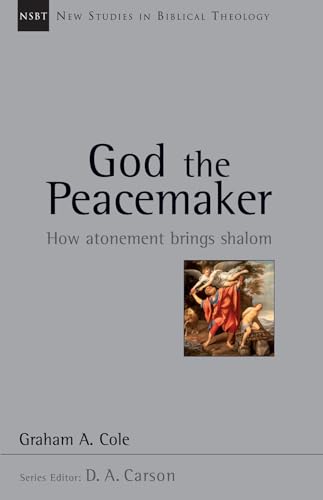
God the Peacemaker: How Atonement Brings Shalom
Written by Graham A. Cole Reviewed By Mary L. VandenBergGraham A. Cole, Professor of Biblical and Systematic Theology at Trinity Evangelical Divinity School, offers students and scholars an overview of the doctrine of the atonement, including the ongoing debates surrounding this doctrine. Using the narrative of Scripture as his guide, Cole paints a rich theological picture of atonement as God’s project for restoring shalom to a sinspoiled creation.
Cole begins by letting his readers know the overall theological framework from which he is working. He affirms the primacy of Scripture for drawing theological conclusions: “If a putative doctrinal proposal is textless—that is to say, it lacks biblical support—then it may be held as a speculative possibility but not as a candidate for a non-negotiable conviction expressing the Faith” (p. 27). He also lays out the scope of his project in this introductory chapter, offering a list of questions this study will address, as well as suggestions for reading the book in part or as a whole.
With introductory matters behind him, Cole commences his discussion of atonement. His opening explanation of the holiness of God sets the stage for a proper understanding of why atonement is necessary. Atonement is not just about human sin. It is about human sin and how that affects the relationship of humans with a holy God. Cole makes this clear, keeping love and justice in careful balance. The great need, as he puts it, is “to be in right relation to the God who created us and has a wise design for human flourishing” (p. 67). He goes on to deal with issues such as the wrath of God, the place of violence in the atonement, expiation versus propitiation, as well as the contemporary questions surrounding justification and the new perspectives on Paul. His treatment is thorough, even touching on the controversial Reformed doctrine of particular atonement at one point (p. 151).
Cole’s thoroughness can at times, however, become pedantic. The explanatory footnotes are extensive and sometimes distracting. At other times, one gets the impression that he simply did not know how to properly limit his subject, an impression also left by the appendix. This level of detail could be difficult for all but the most serious students to wade through. On the positive side, the topics he raises and the references he gives related to those topics offer numerous research opportunities for interested scholars.
Cole is generally fair in dealing with viewpoints that differ from his own. He points out what he considers to be the strengths and weaknesses of the various atonement models on the basis of the biblical text. The one exception to this is how he deals with penal substitution. Clearly he is an advocate for the centrality of this model. He is at times, however, dismissive of arguments that question the model, even arguments that agree with the notion that substitution is biblically crucial but question the validity of the “penal” aspect of the model (pp. 138–41; 238–39). Given his assertion that the language of “penal substitution” is historically rather recent (p. 234), one cannot help but question whether some of the texts he cites as obvious support for penal substitution are not quite as obvious as he purports.
The weakest section of Cole’s work is in chapter 8 where he deals with how an understanding of Christ’s atoning work should affect Christian practice. Cole correctly asserts that “belonging to Christ means living for him—or at least it ought to” (p. 192). While he goes on to describe various ways that a Christ-like life might manifest itself, one is left with the impression that this is fully the work of the believer. The cooperation of the Holy Spirit with the believer in sanctification is never mentioned. In fact, he does not mention the work of the Spirit at all until the very end of the chapter, giving the reader the sense that the Spirit’s work in the believer’s post-regeneration life is something of an afterthought. This oversight has the potential to feed the mistaken notion that justification and sanctification are separate; that salvation equals justification only and sanctification is somehow optional, dependent on the believer’s determination. Perhaps, however, Cole addresses this issue in one of his other publications that deal specifically with the doctrine of the Holy Spirit.
One additional disappointment was the almost complete absence of a connection between the atonement and the renewal of all things. Although Cole recognizes the broad sense of shalom as creational flourishing (p. 22), and even promises to explain the “peace dividend” as having cosmic consequences (p. 30), he never substantively delivers on that promise. A short two paragraphs is given to “the groaning of creation” (pp. 82–83) and only a few pages to “peace for the cosmos” (pp. 181–84). The bulk of his work focuses on the effects of atonement on the relationship between God and human persons.
These weaknesses are minor, however. In contrast to many modern theological works that rely heavily on sources outside the biblical text, Cole’s work on atonement is refreshing in its reliance on Scripture. He begins his arguments by looking to the Bible, asking questions that arise from the text. At every subsequent bend in the road of his theological development, he turns to Scripture for support. While one may quibble with his interpretation of various texts or his use of a particular text at certain points, the fact that he is concerned that his theology be biblically grounded should be heartening for evangelicals and others whose primary concern is whether a position is biblically defensible. Overall, Cole’s book is a helpful introduction to the multifaceted topic of atonement theology.
Mary L. VandenBerg
Calvin Theological Seminary
Grand Rapids, Michigan, USA
Other Articles in this Issue
Most of our readers are theological students and pastors...
The Dazzling Darkness of God’s Triune Love: Introducing Evangelicals to the Theology of Hans Urs von Balthasar
by Stephen M. GarrettJürgen Moltmann observes that Christian theology and the Church face “a double crisis: the crisis of relevance and the crisis of identity...
Plots, Themes, and Responsibilities: The Search for a Center of Biblical Theology Reexamined
by Daniel J. BrendselIn the prolegomena to his “approach to biblical theology,” Charles H...
Since the mid-twentieth century biblical scholars have increasingly accepted that the texts of the Bible must be interpreted in terms of their literary genres...
The present age tends to regard polemics, theological controversies, and all-round doctrinal fisticuffs as, at best, a necessary evil, at worst, one of the most revolting aspects of Christianity...
Other Reviews in this Issue