
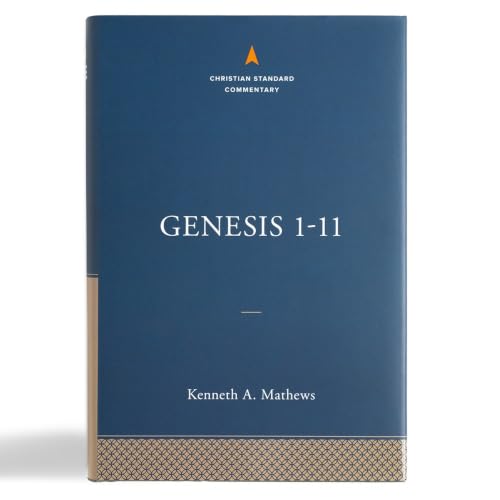
Genesis 1–11
Written by Kenneth A. Mathews Reviewed By Dustin BurletThe Book of Genesis stands “second to none” concerning its import for understanding God’s plan(s) and purpose(s) for creation (p. 5). Kenneth A. Mathews asserts that Genesis “presents the literary and theological underpinning of the canonical Scriptures. If we possessed a Bible without Genesis, we would have a house of cards without [a] foundation” (p. 5). Originally released over twenty-five years ago as part of the New American Commentary series (Nashville: Broadman & Holman, 1996), Mathews has reworked his esteemed commentary for a new generation.
The Christian Standard Commentary (CSC) aims to “embody an ‘ancient-modern’ approach” (p. ix). This involves bringing together careful exegesis, theological insight, and rigorous scholasticism alongside practical relevance and application to the “building up of Christ’s church and the Great Commission to which all are called” (p. xii). One may say that this commentary has thoroughly succeeded!
Akin to its predecessor, Genesis 1–11 is arranged according to six major sections: (1) The Creation of Heaven and Earth (1:1–2:3); (2) The Human Family in and outside the Garden (2:4–4:26); (3) Adam’s Family Line (5:1–6:8); (4) Noah and His Family (6:9–9:29); (5) The Nations and the Tower of Babel (10:1–11:9); and, lastly, (6) Shem’s Family Line (11:10–26).
Regarding the commentary proper, Mathews skillfully arranges the content into clearly defined, funnel-shaped pericopae. He starts with a broad literary unit, such as, “Creation of Heaven and Earth” (Gen 1:1–2:3), and then subdivides it into smaller segments, such as “Creator and Creation” (Gen 1:1–2), and even smaller units, like “In the Beginning” (Gen 1:1).
Important text-critical and lexical details are readily accessible. Key literary and narratival links (intertextuality) are also clearly elucidated. Pastors and other ministry leaders will appreciate the author’s emphasis on application. Mathews’s poignant and thoughtful comments on spiritual formation (alongside the text’s relationship to certain socio-political/cultural matters, such as abortion, capital punishment, gender dynamics, and racism, for example) are evenly interspersed throughout the commentary. By way of example, concerning Genesis 9:1–7, Mathews states: “Human life must be treated with special caution … because it is of singular value as life created in the ‘image of God’ (v. 6)…. The basis of the prohibition against taking human life is rooted in the transcendent value of human life conferred at creation” (pp. 377–78).
Concerning revisions, one notes the not insignificant change in Bible translation from the New International Version (1984) to the Christian Standard Bible. There is also a new five-page “select” bibliography (see pp. xiii–iv), some welcome modifications to various charts, tables, diagrams, and graphics, enhancing their readability and user-friendliness. The language and terminology have been updated throughout, and most importantly, new footnotes and five new excursuses (roughly fifty pages!) provide effective summaries on topics including “The Interpretation of Genesis in the Modern Period,” “Genesis 1–11 and Ancient Literature,” “Creation Narratives and Modern Science,” “Life Spans of the Patriarchs,” and “The Flood Narrative.”
Despite Mathews’s careful attention to detail alongside his enviable pastoral and pedagogical sensitivity, it is unfortunate that his astute insights may, unfortunately, only be appreciated by those already within the so-called “conservative” camp. Concerning “Theological Interpretation of Scripture” (TIS) Mathews argues that the Bible is theological revelation “through Sacred Writ” so that we may “know about God and know God” (p. 15, italics original). Elsewhere, Mathews explicates: “The character of Genesis requires me to read it as reporting in narrative true historical events. Indeed, it requires such an approach if I am to let Genesis speak on its own terms. The search for meaning involves the tandem of biblical content and the literary genre that conveys the message” (pp. 6–7, italics original).
As per the original Genesis 1–11:26 commentary, there is often an acute awareness of the pronounced difference between various verbal stems (Qal, Piel, Pual, Hophal, etc.), coupled with substantial engagement with standard Hebrew reference grammars (IBHS, GKC, Davidson) and informed nomenclature (one notes, for example, the concerted use of the term wayyiqtо̄l). While the author does not refer to David J. A. Clines’s Dictionary of Classical Hebrew (Sheffield: Sheffield Phoenix, 1993–2016, now appearing in its second edition), several other prominent lexicons are cited (TDOT, TWOT, HALOT, BDB). It is rather strange, though, to see BAGD cited instead of BDAG (cf. p. 332).
A more disconcerting matter, however, is the absence of any references to BHQ. Other noteworthy volumes absent from Mathews’s commentary include the work of David M. Carr, Georg Fischer, Julie Galambush, J. C. Gertz, Dru Johnson, Carol Kaminski, Thomas Keiser, James Chukwuma Okoye, Horst Seebass, and Andrew Steinmann.
Mathews’s discussion of the relationship between the beaker and the Bible is easy to appreciate, as he consistently and effectively avoids ad hominem attacks and “strawman” arguments, particularly in his excursus, “Creation Narratives and Modern Science” (pp. 532–44). Concerning JEDP and the documentary hypothesis, Mathews judiciously states that “duplicates” in the Flood account are “better attributed to rhetorical effect than different literary sources” (p. 573). Despite these strengths, some readers may still quibble with his assertions on the Flood:
If read as a literal description, there can be no dispute that the narrative depicts the flood in the language of a universal deluge…. Some believe, however, that the passage is using hyperbole … or is a phenomenological depiction … permitting the possibility of a local flood. In either case, the meaning is not substantially altered: all that Noah and his generation know is swallowed up by the waters so that none survives (pp. 349–50).
In contrast, esteemed Hebraist and biblical commentator Bruce K. Waltke (with Cathi J. Fredricks), observes that, while many “evangelicals favor a local flood,” the Genesis “narrator, even allowing for oriental hyperbole, seems to have in mind a universal flood” (Genesis: A Commentary [Grand Rapids: Zondervan, 2001], 314). Waltke further states: “The geological arguments favoring a local flood assume that the history of the earth’s geology is uniform, but the text represents a geological cataclysm and a re-creation of the earth” (p. 315). Viewing the Genesis Flood account as depicting a local or regional flood also raises certain questions about how best to interpret the (universal) covenant God made with Noah and all future generations (see Dustin G. Burlet, Judgment and Salvation: A Rhetorical-Critical Reading of Noah’s Flood in Genesis [Eugene, OR: Wipf & Stock, 2022]).
These minor criticisms notwithstanding, many preachers, pastors, Christian ministry leaders, Bible college and seminary students, and (one hopes!) invested laypeople will find this commentary a helpful resource at multiple levels, particularly those unfamiliar with the first edition.
Dustin Burlet
Millar College of the Bible
Winnipeg, Manitoba, Canada
Other Articles in this Issue
Editorial: Announcing the Carson Center for Theological Renewal
by Brian J. Tabb and Benjamin L. Gladd
A Change in Kind, Not Degree: Labels, Identity, and an Evaluation of “Baptistic Congregationalists”
by Nathan ShermanHow do we decide what to label people of centuries past when they had no clear labels for themselves? Should we describe seventeenth century Baptists as “Baptists” if that was not what they called themselves? Matthew Bingham has recently argued that instead of using the label “Particular Baptists” for the English Calvinistic Baptists of the 1640s and 50s, historians would more clearly describe their subjects as “baptistic congregationalists...
Filial Revelation and Filial Responsibility: (Dis)obedient Sonship and The Religious Leaders in Matthew 11–16
by Adam FriendSonship appears in every section, at every turning point, and on the lips of every character in Matthew’s Gospel...
This paper articulates a provisional thesis, namely, that we need a pedagogical category within our biblical theological frameworks, on the basis that such a category was in the New Testament authors’ minds...
Scholars disagree about the precise nature of the sin that provokes God’s wrath in Genesis 19...
Other Reviews in this Issue