
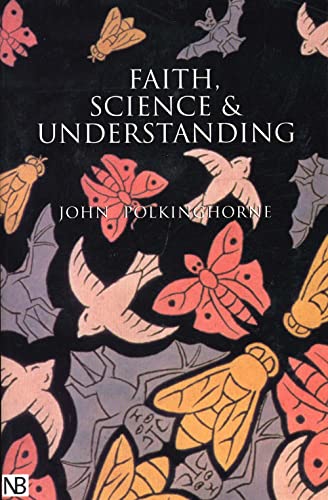
Faith, Science and Understanding
Written by John Polkinghorne Reviewed By Philip DuceSir John Polkinghorne’s reputation as an influential ‘scientist-theologian’ is now well-established through his substantial programme of books. His latest offering is another ‘further thoughts’ volume (xi) (the first was Reason and Reality (SPCK, 1991)), in which he revisits issues in the burgeoning field of the relationship between science and Christian theology.
Part 1 begins with a defence of the value of knowledge for its own sake, and its essential unity, based on the conviction that knowledge is the exploration of a created reality, itself given value by the love of its creator God, who is one. Science and theology, in their differing domains of experience, are concerned with the search for truth, attained by the formation and evaluation of motivated beliefs. For Polkinghorne, these concepts are the foundations on which the life of a university should be built: if theology does not make its own distinctive contribution, the enterprise of higher education is incomplete.
Polkinghorne reiterates his commitment to critical realism, in both science and theology, as a middle way between intellectual certainty (of the Enlightenment, modernist variety) and intellectual doubt. Science is not driven into a despairing relativism by the collapse of modernity. ‘The most helpful philosopher of this middle way is … Michael Polanyi’ (33). Furthermore, Polkinghorne advocates a ‘generous, comprehensive and non-reductionist account of human experience’: so, for example, ‘we should not exalt science at the expense of art’ (28).
Such affirmations are undoubtedly welcome. However, the discussion of the role of revelation remains problematic and unsatisfactory from an evangelical perspective. For Polkinghorne, revelation (including the Bible) is a meaningful record of encounters and experiences, and reflection upon them, rather than the communication of unchallengable propositions (ch. 2). These alternatives are set up tendentiously, and conveniently avoid a nuanced evangelical doctrine of revelation and Scripture, which is not mentioned at all. Furthermore, faced with the ‘apparent cognitive clashes of the world faiths’, Polkinghorne’s position leaves him with little to say in the way of resolution (65).
Chapter 4, a useful discussion of design in biology, acknowledges that the revival of teleological issues has raised important and significant questions. However, for Polkinghorne it seems premature to conclude that an essential irreducible complexity in biological systems has been firmly established by the ‘intelligent design’ movement of Behe, Dembski et al. Part 1 concludes with further remarks on a number of issues, including a concise critique of the panentheism expounded by Philip Clayton in God and Contemporary Science (Edinburgh University Press, 1997).
Part 2 ‘is concerned with what was the dominant issue in the science and theology debate in the 1990s: How may we conceive of divine agency in a way that respects the integrity of the scientific account of the process of the physical world and which also does justice to the religious intuition and experience of God’s providential action in history?’ (xiv). A key concept in the discussion is the idea that creation was an act of divine kenosis (ch. 6). Chapter 7 is quite demanding in its exploration of the nature of time and the possible links between scientific, metaphysical and theological ideas. It provides an interesting outline and analysis of four main approaches, with a closing note on process thought.
Part 3 offers some engagement with contemporary thinkers (Wolfhart Pannenberg, T.F. Torrance and Paul Davies), and concludes with a brief survey of the history of science and theology in England.
Overall, then, this is a stimulating and enjoyable book, worth reading, but requiring awareness of, and critical engagement with, the parameters of Polkinghorne’s synthesis.
Philip Duce
Leicester
Other Articles in this Issue
Other Reviews in this Issue
The Johannine Literature
Reviewed by Alistair I. Wilson