
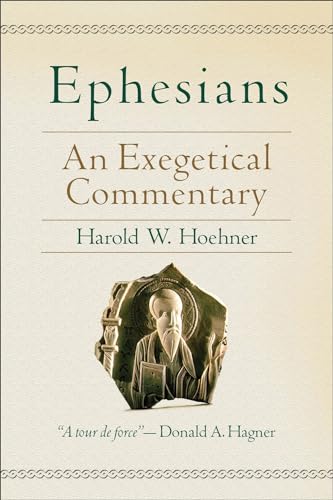
EPHESIANS AN EXEGETICAL COMMENTARY
Written by Harold W. Hoehner Reviewed By Andrew D. ClarkeOne of the dominant questions that is pursued by scholars of Ephesians concerns its authorship and destination. The headline statement which is made in this massive commentary is a resounding defence of the traditional view: the letter is both by Paul and to the Ephesians. These conclusions are supported by extensive exploration, discussion and evaluation; indeed, nearly 60% of his lengthy introduction is devoted to the defence of Pauline authorship. The remaining discussion is focused on the genre, setting, purpose and theology of the letter. In his analysis of 279 scholars from 1519 to 2001, Hoehner determines that the division between those who conclude in favour of or against Pauline authorship is equal. This willingness to compare the broadest body of commentators, together with his careful assessment of the evidence, will be of considerable value to those students of Ephesians who wish to review the history of scholarship as part of their investigation into this long-standing debate. The dominant conclusions regarding authorship, however, will inevitably be a determining factor in the reception which the commentary secures for many people.
The commentary has benefited from a long incubation, reflected in the extent that Hoehner has characteristically been meticulous in detail and exhaustive in his reading. This is demonstrated by his average of 5 pages of detailed discussion per verse of Ephesians. For reasons of space, the decision was reached not to include a complete bibliography of works cited through the course of the commentary (24 pages are devoted merely to the author index). Nonetheless, two shorter bibliographies including only commentaries on Ephesians and works which focus on the authorship of Ephesians are incorporated. This commentary is traditionally historical-critical in focus, incorporating careful use of word studies, detailed explanation of grammatical issues, investigation of significant textual variants (normally placed in footnotes), all within a theological framework.
This is a commentary on the Greek text of Ephesians. Each verse is cited in Greek followed by the author’s translation. The commentary then explores a phrase at a time, repeating the Greek text and the English translation at all points of detailed discussion. Although students without Greek (and, to a lesser extent, those without Hebrew) are disadvantaged, they are aided by the widespread juxtaposition of Greek alongside a translation. Nonetheless, the complex discussion of Greek grammar may prove a greater challenge in following Hoehner’s basis of argument. The commentary is enhanced by the occasional brief excursus on additional matters which require further elucidation.
For many, Hoehner’s commentary will be invaluable either for general academic study or for detailed research; for some it will also prove indispensable for background study prior to sermon preparation. It is, however, clearly framed as an exegetical, rather than expository commentary, and does not aim to devote significant space to application within a church context. It is most accessible to those students of the word who have at least a couple of years of academic study of the New Testament.
Andrew D. Clarke
Andrew D. Clarke
University of Aberdeen
Aberdeen, Scotland, UK
Other Articles in this Issue
Other Reviews in this Issue