
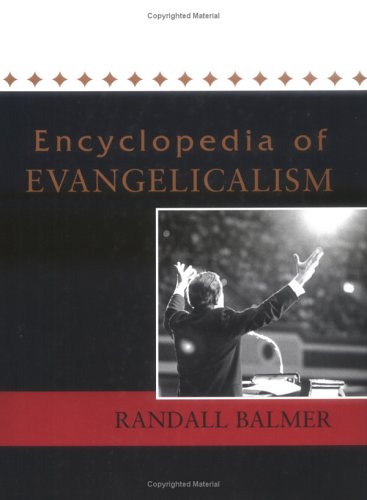
ENCYCLOPEDIA OF EVANGELICALISM
Written by Randall Balmer Reviewed By John CoffeyDespite its title, this is not an encyclopedia of evangelicalism per se, but an encyclopedia of North Americanevangelicalism. Readers who wish to learn about Brazilian Pentecostalism, Chinese house churches or evangelical revivals among European gypsies will be disappointed. A number of British are included, but Wesley, Wilberforce, Stott, Packer, Tom Wright and Cliff Richard only merit an entry by virtue of their renown in the USA. Indeed, the encydopedia may give uninformed readers the unfortunate impression that evangelicalism is a largely American movement rather than a genuinely global one. What is more, although Balmer is thoroughly familiar with American evangelicalism’s past, this work is predominantly focussed on its present.
However, as an encyclopedia of contemporary North American evangelicalism, this work is unrivalled, and it is a remarkable achievement for a single scholar. The text is entirely written by Balmer, a professor of American Religion at Barnard College, Columbia University, whose previous works include Blessed Assurance: A History of Evangelicalism in America, and Mine Eyes have Seen the Glory: A Journey into the Evangelical Subculture in America. It is particularly strong on the institutions that have shaped American evangelicalism, and contains concise entries on hundreds of denominations, colleges, seminaries, missionary societies, and ministries. The encyclopedia is also teeming with evangelical lives, and gives a vivid impression of how the movement has been shaped by a colourful cast of intellectuals, musicians, pastors, evangelists, faith healers, philanthropists and activists. Balmer knows his evangelical theology, but he is also attuned to evangelicalism as popular culture, and entries on theologians like Don Carson; Carl Henry; Clark Pinnock and David Wells are juxtaposed with ones on Arthur Blessitt; Amy Grant; Tim LaHaye and Promise Keepers. There could perhaps have been more topical entries (one is struck by the absence of Bible studies, home groups, and prayer meetings), but the ones that are included are often inspired—my own favourites include flanneigraph; gnomic Hebrew monikers; overhead projector; Pentecostal handshake; Sword Drill and Just (as in ‘Lord, we just wanna thank you’). As in every encyclopedia, there are surprising omissions (Gordon Clark is included, but Bernard Ramm is not; YWAM is here, but not OM), but this is still a remarkably comprehensive reference book and the brief bibliographies following each entry are an education in themselves. At times one can detect Balmer’s own sympathies and prejudices (he admires ‘progressive’ evangelicals like Tony Campolo and Jim Wallis, but has less respect for creationists, fundamentalists, strident Calvinists, strict inerrantists and popular prophecy teachers). Some of the entries are witty, gossipy or even mildly satirical, though on the whole Balmer manages to bring his subjects to life whilst remaining reasonably objective.
Inevitably, an encyclopedia like this raises the vexed problem of defining evangelicalism. Balmer admits that he has ‘defined evangelicalism rather broadly, even though I know that many of the people and organisations treated here prefer a more restrictive interpretation’. Whatever one thinks of such a ‘latitudinarian approach’, it allows Balmer to do justice to the various evangelical tribes—Fundamentalists, Dispensationalists, Reformed, Methodists, Southern Baptists, African-Americans, Pentecostals and charismatics all receive generous coverage.
John Coffey
University of Leicester
Other Articles in this Issue
Other Reviews in this Issue
GOD’S DESIGN FOR WOMEN
Reviewed by Laura Jervis