
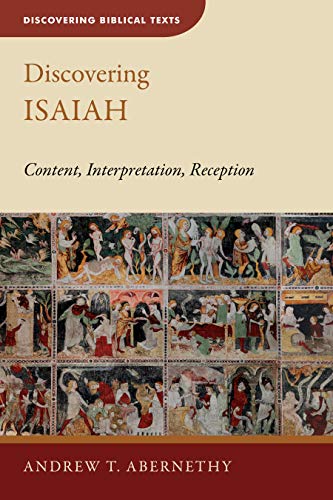
Discovering Isaiah: Content, Interpretation, Reception
Written by Andrew T. Abernethy Reviewed By Drew N. GrumblesDiscovering Isaiah aims to introduce students and pastors to the majestic book of Isaiah and its long history of scholarship. Andrew Abernethy, who has written several other monographs on Isaiah, successfully and concisely accomplishes this end. In The Book of Isaiah and God’s Kingdom, NSBT 40 (Downers Grove, IL: InterVarsity Press, 2016), Abernethy explored the prophet’s work thematically, showing how “kingdom” is one of the unifying theological themes of Isaiah. In contrast, Discovering Isaiah combines the historical, literary, and reception history approaches (p. 4).
After an introductory chapter, chapters 2–3 explore the reception history of Isaiah. Chapter 2 covers pre-modern readings of Isaiah, including inner-biblical interpretation, apocryphal texts, the Qumran community, the early church, the Middle Ages (including Jewish rabbinics), and the Reformation period. Of particular interest is how Abernethy opens up the Christological hermeneutic employed by the pre-modern church. He claims that, for Eusebius, a “plain” or “literal” reading of the text includes following “the plain sense of the text across the entire sweep of redemptive history” (p. 16). Calvin, though focusing carefully on the meaning of the text for its eighth-century audience, also “reads forward” to Christ and the church (p. 23).
In chapter 3, Abernethy succinctly summarizes modern scholarship and its dissection of Isaiah into different authors and texts. He also deals fairly with conservative scholars who see a single author for Isaiah. Ultimately, it is not clear exactly what Abernethy himself believes about different authors and historical settings, but he focuses on the canonical, final form of the book (p. 37).
In chapter 4, Abernethy takes a historical approach to the study of Isaiah. He does not trace the history of the text, but the history that Isaiah presents. Abernethy claims that Isaiah is a theological history, presenting God as simultaneously a God of judgment and salvation. This theme can be seen in Isaiah 1–12, the opening section of the book. The author then argues for four “phases” in this history of Israel: judgment from Assyria and Babylon; the rebuilding under Cyrus; the redemption through the Suffering Servant; and the final consummation of judgment and salvation. Each of these phases contains instances of both judgment and salvation, a pattern that repeats until the escalation at the end of time.
In chapters 5–9, Abernethy uses a mainly literary approach to studying Isaiah. That is, he looks at various themes throughout the book. The key themes he examines are holiness, Zion, the Davidic Messiah, the Suffering Servant, and justice. In these chapters the reader can see how Abernethy combines approaches. After some time examining each theme across the book of Isaiah, he applies each theme to each of the aforementioned four historical “phases.” Then he sifts each theme through its reception history, showing how various scholars and theologians across the ages have interpreted them. He ably demonstrates how Isaiah portrays holiness as the most important attribute of God in the book and how Zion is the most important motif of the book (p. 75). Chapter 8, on the Servant, is excellent, describing the passage as dream-like, with the audience hardly able to comprehend how God could provide such a Servant (pp. 132–33). Chapter 9 provides an interesting discussion of justice. Abernethy acknowledges that the term today is rife with political overtones (p. 144), but in this chapter he defines “social justice” simply as “God’s concern for justice at a social level, particularly God’s concern that the socially vulnerable receive just treatment within society” (p. 144). Although much debate today centers on how this is to be evaluated and applied, especially in Western society, Abernethy (largely) steers clear of political controversy in this book. Lastly, a brief concluding chapter (chapter ten) shows how Isaiah’s ultimate goal is for readers to worship YHWH.
The book has no glaring weaknesses, but a few small deficiencies can be noted. In chapter 7, the author primarily focused on Isaiah 7 but could have used that space to examine more closely other passages related to kingship. Also, it is debatable if “justice” should be included as one of the top five themes of Isaiah. Why not choose, say, the nations as a theme?
A few features make Discovering Isaiah stand out. First, the work is simple and brief without sacrificing scholarly depth. Second, Abernethy writes from an evangelical perspective that is charitable to conservative views on Isaiah. Third, Abernethy focuses on the final form of the book of Isaiah. Although an understanding of the scholarly discussion of Isaiah is necessary for students, such study misses the great Isaianic forest for the historical-critical trees. Thus, if a reader wants knowledge both of the scholarly reception of Isaiah and also wants to understand what Isaiah proclaims theologically, this book is the one to consult. Other works such as the T&T Clark Study Guides to the Old Testament do not present a final-form theological look at Isaiah. Discovering Isaiah is more like a chapter in an introductory OT textbook, except that, being a monograph, it has the benefit of exploring ideas in more depth.
In sum, Discovering Isaiah is worth reading because Abernethy will help you know Isaiah better, whose book, in turn, will direct you to “behold your God” (Isa 40:9).
Drew N. Grumbles
Albany Baptist Church
Albany, New York, USA
Other Articles in this Issue
Menzies responds to Tupamahu’s post-colonial critique of the Pentecostal reading of Acts and the missionary enterprise...
The Lamblike Servant: The Function of John’s Use of the OT for Understanding Jesus’s Death
by David V. ChristensenIn this article, I argue that John provides a window into the mechanics of how Jesus’s death saves, and this window is his use of the OT...
Geerhardus Vos: His Biblical-Theological Method and a Biblical Theology of Gender
by Andreas J. KöstenbergerThis article seeks to construct a biblical theology of gender based on Geerhardus Vos’s magisterial Biblical Theology...
Is the One God of the Old Testament and Judaism Exactly the Same God as the Trinitarian God—Father, Son, and Holy Spirit—of the New Testament and Christian Creeds?
by John Jefferson DavisThis article argues that the One God of the Old Testament and Judaism is exactly the same God as the Trinitarian God of the New Testament and Christian creeds...
A well-known Christian intellectual and cultural commentator, John Stonestreet, has often publicly spoken of the need for Christians to develop a theology of “getting fired...
Other Reviews in this Issue