
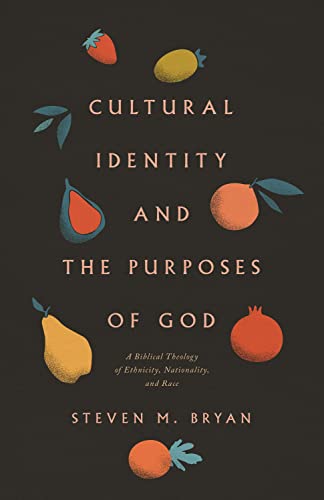
Cultural Identity and the Purposes of God: A Biblical Theology of Ethnicity, Nationality, and Race
Written by Steven M. Bryan Reviewed By Jessica UdallAs Christians, how should we think about cultural identity? In this book, Bryan shows that far from being a result of the fall or a by-product of Babel, cultural diversity has been an integral part of God’s vision for humanity all along. “Although many have thought of Scripture as the story of God’s purposes for individuals,” he observes, “that is only part of the story.” Rather, the Bible “also reveals the purposes of God for peoples” (p. 34).
To demonstrate this, Bryan returns to the beginning, asserting that even before sin entered the world, humans were created to scatter, multiply, be fruitful, and fill the earth. The dispersion of diverse image bearers brings him glory by portraying God in his multi-faceted fullness. Chapters 1 through 5 cover the Old Testament, exploring themes of God’s vision for cultural identity and how it can be twisted through humanity’s rebellions. This section also examines the hope for restoration that will only come through God Himself becoming part of a people in order to redeem a people from all peoples for Himself.
In chapters 6 through 10, Bryan moves on to the New Testament, considering the abundant missional hospitality of the Messiah in the Gospel of Matthew, who invites “Israel in its Messianic form [to become] a host for all peoples—including ethnic Israel itself” (p. 153). Furthermore, Bryan describes the open temple in the Gospel of John and Paul’s counsel on the practices of multicultural communities of faith in order to continue to show God’s plan for his redeemed people from varied cultural backgrounds to live together in a still-diverse unity. The meaning of cultural renewal through the work of the Holy Spirit is also explored, particularly the idea that “if Babel represented human resistance to the divine purpose of an earth filled with diverse peoples unified in the worship of God, Pentecost represents the fulfillment of them” (p. 172).
The penultimate chapter discusses Revelation’s vision of “all peoples as one people” worshipping God (p. 239). The final chapter presents the local church as the hope for a way of living that does not fall into the equally destructive ditches of violent inter-ethnic conflict on the one side and totalizing cultural uniformity on the other (p. 82).
Bryan roots a gospel-empowered third option for dealing with cultural difference—the way of love—in the Trinitarian God himself, who exists in an eternal dance of loving relationship with difference even within his own unity (p. 199). Indeed, if difference is eliminated in favor of the homogeneity of sameness, love is also eliminated, since love requires an “other.” Particularity has always been part of God’s plan, from his choice of one people, Israel, to Christ’s incarnation within a specific culture. God’s choice of a particular people was never the end goal. Instead, God intended the particular, chosen people of Israel to be the agents of universal blessing. In Christ, we who are reconciled to God through Christ become ministers of that reconciliation for others, and we get the joy of experiencing the reciprocal relationship of brotherhood with others who worship the Lord with cultural expressions that are different from our own, thus reflecting the multifaceted glory of the God who created cultures.
Instead of cherry-picking prooftexts as low-hanging fruit and calling it a day, Bryan considers Scripture as a whole and systematically exegetes his way through the entire biblical narrative in order to discern overarching themes stretching from Genesis to Revelation, which shed light on God’s intentions for cultural diversity. Thus, he convincingly proves his thesis that “every culture has its own shape that frames the stories of individual lives,” and “those stories come together and find their meaning within the story of God’s creation of a new humanity in Christ” (p. 261).
Bryan’s decades of cross-cultural ministry also give his words resonance and relevance across cultural barriers, because his perspective has been honed in the day-to-day experience of cross-cultural relationships as a long-time theological educator in Ethiopia in the same city where I now live and in the same field where I work. The nuanced presentation of cultural complexities, along with a clear-eyed, whole-Bible argument for cultural diversity as a key part of God’s plan, can serve to provoke thought and jumpstart (hopefully cross-cultural) conversations among Christians seeking to walk in love and mutual appreciation with those from different cultural backgrounds. A robust discussion question section at the back of the book will also benefit readers who desire to implement Bryan’s suggestions into their ministry context.
I recommend this book to anyone who is looking to move beyond a merely individualistic understanding of their faith and who is curious to explore the idea that God’s work in the world has always been focused not only on people but on peoples. Students of theology and intercultural studies will find a helpful companion for their own study of Scripture with regard to the purpose of culture as part of God’s eternal plan. Those who are engaged in cross-cultural relationships of any kind will also be edified by reflecting on the riches that each culture possesses as gifts from God, which can be used to glorify Him and can be shared with others across lines of cultural difference for mutual blessing.
Jessica Udall
Jessica Udall
Columbia International University
Columbia, South Carolina, USA
Other Articles in this Issue
Menzies responds to Tupamahu’s post-colonial critique of the Pentecostal reading of Acts and the missionary enterprise...
The Lamblike Servant: The Function of John’s Use of the OT for Understanding Jesus’s Death
by David V. ChristensenIn this article, I argue that John provides a window into the mechanics of how Jesus’s death saves, and this window is his use of the OT...
Geerhardus Vos: His Biblical-Theological Method and a Biblical Theology of Gender
by Andreas J. KöstenbergerThis article seeks to construct a biblical theology of gender based on Geerhardus Vos’s magisterial Biblical Theology...
Is the One God of the Old Testament and Judaism Exactly the Same God as the Trinitarian God—Father, Son, and Holy Spirit—of the New Testament and Christian Creeds?
by John Jefferson DavisThis article argues that the One God of the Old Testament and Judaism is exactly the same God as the Trinitarian God of the New Testament and Christian creeds...
A well-known Christian intellectual and cultural commentator, John Stonestreet, has often publicly spoken of the need for Christians to develop a theology of “getting fired...
Other Reviews in this Issue