
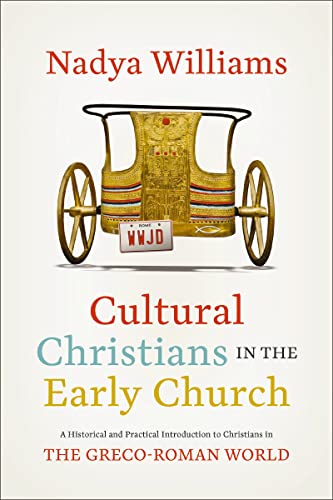
Cultural Christians in the Early Church: A Historical and Practical Introduction to Christians in the Greco-Roman World
Written by Nadya Williams Reviewed By Steve WaltonThis is an unusual, and unusually important, book. Dr Williams was until recently professor of ancient history at the University of West Georgia (for her fascinating account of choosing to leave academia, see “Discerning Vocation: Walking Away from Academia,” Anxious Bench, 10 May 2023, https://www.patheos.com/blogs/anxiousbench/2023/05/discerning-vocation-walking-away-from-academia/), and her learning and understanding come through clearly and lucidly in this book. She is writing in part in response to the frequent assumption that the early Christians were vastly better Christians than we are today, which she rightly argues leads to errors in discipleship in the present. She also aims to paint in key parts of Greco-Roman culture to enable readers to see the cultural sea in which the early Christians swam. A better understanding of ancient culture enables (western) Christians today to recognize Christian cultural temptations and sins in that setting. She also aims to highlight related modern (western, especially American) Christian cultural sins which show up in relation to money, marriage, sexuality, and politics. She acutely observes, “trying to fix the world through politics or just through policies on marriage … will never work. Rather, we need to pursue genuine conversion and sanctification” (p. xv).
“Cultural Christians” are those who profess to follow Jesus, but whose lives demonstrate that they follow what their culture expects. Thus “cultural sins” are “bypass[ing] God’s standards to engage in certain culturally conditioned and approved behaviours” (p. xv—I like that she names them “sins,” calling a spade a spade). Cultural religion is the norm in the Greco-Roman world: generals offered sacrifices to the gods or sought divine guidance before going to battle, and political leaders were frequently also priests of religion. “Religion” was not one sphere of life separate from others, such as politics or work, but permeated the whole of life. It was common to bargain with the gods, to find the correct sacrifice to offer to persuade the gods to give the outcome the sacrificer desired. Here is the focus of this book, for Dr Williams argues cogently that cultural sins exist among Christians in the first five centuries AD and shows how Greco-Roman cultural values and expectations are evident from sources for that period.
Dr Williams is not writing to criticize, but to alert today’s Christians to consider and act on the cultural sins which we are engaged in. She is not pointing fingers at others, but writes for all Christians, “the average church-goers not only in antiquity, but also today” (p. xxvii). Each of the chapters then considers a particular period and/or location in these five centuries to illustrate and expound Dr Williams’s thesis.
Consider the sharing of possessions in the earliest churches (ch. 1). Her case studies here are Barnabas (Acts 4:36–37), whom she considers a “cultural Jew” before his conversion on the ground that Levites were not supposed to have land, and Ananias and Sapphira (Acts 5:1–11), who meet God’s judgement for their lies. She surveys property ownership among Jews of the period, noting Jesus’s criticism of those who are rich at others’ expense in contradiction of the (OT) scriptural commands to provide for those in need. Roman euergetism, providing from one’s wealth for a city or community, led to glory and honour for the giver. Barnabas is counter-cultural in giving so generously, whereas Ananias and Sapphira are acting with the grain of the culture in seeking honour for themselves because of their gift. As modern examples, Dr Williams mentions the sacrificial giving in adopting a child (especially later in life, seeing taxation as a way of caring for those less fortunate), and attitudes to immigration and foreign aid.
Chapter 2 considers food and drink in similar manner, noting that some food, notably meat, could be linked to idolatry—and that meat was often luxury food in times of food insecurity. Greek symposia and Roman convivia provide cultural conversation partners, illuminating the cultural sins of the Corinthians’ Lord’s Supper (1 Cor 11). Recent changes in American evangelical attitudes to alcohol and other things lead to the succinct conclusion, “Food is never just food” (p. 39).
Sexuality is a hot issue in western churches and culture today, and chapter 3 highlights how Ovid demonstrates that lust was “the quintessential Roman cultural sin … rooted in display of power that enforced the social structures” (p. 43). Paul’s discussion of sex and marriage in 1 Corinthians shows how current the issues were, and how Christian understanding contrasted with the prevalent cultural norms, particularly in the view of singleness and the dignity of women. The Shepherd of Hermas provides an excellent dialogue partner here and leads to conversation about the way some younger American Christians (and others elsewhere, I would add) both delay marriage and embrace (!) premarital sex, immersed as they are in cultural messages as crude and blatant as in the ancient world.
Cultural pressure leading to apostasy from Christian faith follows, in the NT period and later (ch. 4). Pliny the Younger’s puzzlement over Christians in the province of Bithynia-Pontus, where he was governor early in the second century, sets the scene in a creative reconstruction of the situation he faced (pp. 64–75). A conversation with 1 Peter, written some time earlier but to the same area, is productive (pp. 75–81), leading to reflection about the cover-up of sexual abuse and abuse of power in today’s churches, which has led some away from the Christian faith.
Female martyrs, notably Perpetua and Felicity, form the next focus, particularly in conversation with Tertullian and Cyprian (ch. 5), leading into a valuable discussion of the way single women of all ages are often ill-served in today’s churches. Dr Williams makes effective points about the way some conservative Christians oppose social programmes that help women of color, who are more likely to be poor, to give birth prematurely, and to die in childbirth, as well as regarding the concern some Christian men express over modesty in female dress (not least Owen Strachan’s misguided comments on leggings [pp. 203–4]), effectively blaming women for men’s sin.
Cyprian’s leadership as bishop of Carthage in the third century is Dr Williams’s next focus, particularly his calling believers to share with each other through prayer, finance, and physical resources (ch. 6). Cyprian identifies the fear of his communities that, if they give to others, they will not have enough for themselves, which demonstrates lack of trust that God will provide for his people. Dr Williams writes in the wake of the COVID-19 pandemic and makes acute observations about the way churches can be a counter-cultural safety net in such times.
The scary world of Christian-on-Christian violence follows (ch. 7), not least after Constantine’s declaring Christianity to be the official Roman religion. North African Christianity, divided between Roman and Donatist believers, provides a worrying example. Many white Christians today believe themselves to be a persecuted minority, casting themselves in the role of martyrs, while forgetting how recently black believers were persecuted and killed by white believers.
Christian nationalism is not a new feature in modern America (and other countries—the Church of England is still the established church), for it faced a crisis with the fall of Rome in AD 410 (ch. 8). Up to that time, the Roman empire was the only cultural and political context Christians had ever known. Augustine’s City of God is a fascinating conversation partner, read as a critique of Christian nationalism. After a fine survey of religion and culture in the Roman empire, Dr Williams reads Augustine as offering a careful reading of this history as an antidote to mistaken belief that God is on the side of the Romans. This has significant implications for how American history is taught in schools (and that of other nations, too).
Finally, Dr Williams considers the desert fathers and mothers, and identifies them as a phenomenon in tune with ancient tourism, as people came from far and wide to visit such believers (ch. 9). This provides a fine conversation with modern believers who abandon meeting in churches and individualise the expression of their faith. Dr Williams rightly observes that many of the key Christian virtues can only be practised in community, rubbing along with other believers different from us.
A brief conclusion reviews the overall argument and calls readers to be alert and attentive to their cultural milieu, so that they can seek to avoid cultural sins.
This is a fine book which deserves wide reading by church leaders and lay people. The cultural pressures facing modern western Christians are not the same as those Dr Williams relates so well, but her work sensitizes us to seek and recognise those pressures, and to resist them.
Steve Walton
Steve Walton
Trinity College
Bristol, England, UK
Other Articles in this Issue
Editorial: Announcing the Carson Center for Theological Renewal
by Brian J. Tabb and Benjamin L. Gladd
A Change in Kind, Not Degree: Labels, Identity, and an Evaluation of “Baptistic Congregationalists”
by Nathan ShermanHow do we decide what to label people of centuries past when they had no clear labels for themselves? Should we describe seventeenth century Baptists as “Baptists” if that was not what they called themselves? Matthew Bingham has recently argued that instead of using the label “Particular Baptists” for the English Calvinistic Baptists of the 1640s and 50s, historians would more clearly describe their subjects as “baptistic congregationalists...
Filial Revelation and Filial Responsibility: (Dis)obedient Sonship and The Religious Leaders in Matthew 11–16
by Adam FriendSonship appears in every section, at every turning point, and on the lips of every character in Matthew’s Gospel...
This paper articulates a provisional thesis, namely, that we need a pedagogical category within our biblical theological frameworks, on the basis that such a category was in the New Testament authors’ minds...
Scholars disagree about the precise nature of the sin that provokes God’s wrath in Genesis 19...
Other Reviews in this Issue