
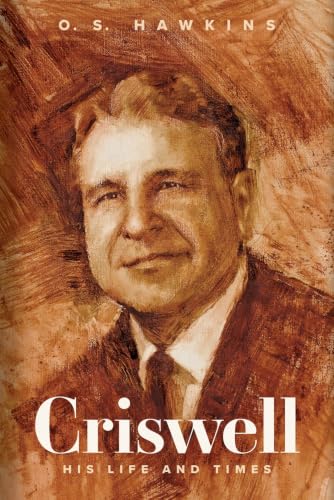
Criswell: His Life and Times
Written by O. S. Hawkins Reviewed By Austin NicholsonW. A. Criswell (1909–2002), one of twentieth-century evangelicalism’s most colorful and influential leaders, pastored the First Baptist Church of Dallas, Texas, for fifty years. For most of his tenure, FBC Dallas enjoyed prestige as the Southern Baptists’ largest congregation and its first metropolitan megachurch. At the height of his career, Criswell became the chief mentor and figurehead for political and theological conservatives within the Southern Baptist Convention (SBC), whose movement fundamentally transformed the denomination by century’s end.
Criswell was as polarizing as he was influential. He appears briefly in many academic histories of Southern reactionaries or the Christian right, often as an example of religious bigotry. Historians highlight his inflammatory statements on racial integration, John F. Kennedy’s Catholicism, and the separation of church and state. Conversely, among his tribe, Criswell is perhaps the most frequently and widely celebrated forefather of the SBC’s “conservative resurgence.” Mainstream Southern Baptists claim him as their own, while fundamentalist and far-right factions in the denomination routinely invoke his memory as a populist rallying cry against the encroaching liberalism of elites. Despite Criswell’s ubiquity as a legend, however, none have undertaken a serious historical assessment of his life.
With his new book, Criswell: His Life and Times, O. S. Hawkins offers the first biography of Criswell in over 30 years and the first since his death. Hawkins, who pastored First Baptist Dallas from 1993–1997, now serves as Chancellor of Southwestern Baptist Theological Seminary after twenty-five years at the helm of Guidestone Financial Resources, a Southern Baptist investment company. Before succeeding Criswell in the pulpit, Hawkins developed a close relationship with him throughout the 1980s, providing a personal connection that both helps and hinders his perspective.
A brief introduction lays out the book’s central thesis: Criswell “made fundamental theology respectable” by combining the influences of George W. Truett and J. Frank Norris (p. 6). Hawkins points readers to his previous book on Truett and Norris, In the Name of God (Nashville: B&H Academic, 2021), which attempted to rehabilitate Norris’s sordid reputation and assert his underappreciated influence on contemporary Southern Baptist conservatives. Hawkins continues the story here, suggesting Criswell “took the best of both men, discarding the worst, far exceeding both of them in lasting gospel influence” (p. 4). Despite the book’s explicit claim to the contrary in the preface, its treatment of Criswell is thoroughly hagiographic from the opening pages.
Chapters 1–4 trace Criswell’s life from inauspicious origins in rural Oklahoma and Texas, to his college years at Baylor, pastoral training at The Southern Baptist Theological Seminary, and early pastorates in Oklahoma. Readers new to Criswell will appreciate the background, but those familiar with his life story will find little of note. These early chapters suffer the most from a problem that plagues the entire book: a heavy dependence on Criswell’s ghostwritten autobiography and oral memoirs, with precious few primary sources to corroborate his telling of events. The use of footnotes rather than endnotes makes this lack of research depth abundantly clear to the reader. On the few occasions another source is consulted, it supports a personal note regarding Hawkins’s relationship to Criswell or a diversion from the main narrative to discuss an event later in Criswell’s life.
Chapters 5–10 survey Criswell’s career in Dallas by decade, beginning with the 1940s and ending with the 1990s. Hawkins focuses almost solely on Criswell’s church work, starting with his rapid overhaul of the staff, educational programming, eschatological views, and preaching style after succeeding Truett in 1944. The 1950s center on the growth of FBC Dallas—both numerical and physical—into a sprawling megachurch with several blocks of downtown property, thanks to the generosity of several wealthy female donors. The 1960s chapter acknowledges Criswell’s opposition to Kennedy’s election, his post-assassination sermon on “The Red Terror,” and barely touches on Criswell’s two terms as SBC president. Hawkins chronicles the establishment of Criswell College, First Baptist Academy, and KCBI radio in the 1970s through Criswell’s eyes, citing a personal interview.
The 1980s chapter climaxes with Hawkins’s assertion that “anyone who lived through the denominational controversy of the 1980s knew that … the undisputed head and leader of the movement by the sheer power of his personality and position was W. A. Criswell” (p. 167). Criswell is not let off the hook for the Patterson-Pressler crusade; he was a “general” who gave “marching orders” (p. 167). From this 30,000-foot view, no hands were dirtied, secular political alliances are out of frame, and the resurgence proved an unmitigated triumph for biblical inerrancy over liberal theology. Even for a sympathetic and Criswell-centered account, this obscures many complexities. When we reach the 1990s, Hawkins acknowledges that Criswell had stayed in his position too long, to the detriment of the congregation’s health. He offers a kinder treatment of Joel Gregory’s doomed succession attempt than previous writers, refraining from the harsh moral indictments of Gregory once commonplace among Criswell acolytes.
Hawkins’s two original contributions receive chapters of their own to close out the book. “Marching to Zion” explores Criswell’s “love and support of the Jewish people,” including his relationships with Jewish leaders in Dallas and multiple Israeli prime ministers (p. 189). While noting Criswell’s conviction that the establishment of the modern state of Israel fulfilled biblical prophecy, his dispensational premillennial theology is not explored in depth. The chapter relies primarily on anecdotes from Criswell’s sermons and a few personal interviews, but it offers a unique compilation of stories with a common theme.
The penultimate chapter, “Three Great Regrets,” contains the book’s most concerning interpretive deficiency and its most substantial contribution. At the end of his life, Criswell expressed regret for his early positions on racial integration, his difficult and distant relationships with his wife and daughter, and his failure to smoothly hand over the pastorate of FBC Dallas. Though acknowledging Criswell’s “racial sins,” especially his 1956 diatribes in South Carolina—an event completely ignored in the 1950s chapter—Hawkins musters only a whitewashed, sanitized retelling (p. 213). He offers no new interpretation of Criswell’s heart or intent in the years between that address and his 1968 flip-flop to embrace desegregation. Instead, over four pages, he rehashes the deeply entrenched racism of FBC Dallas in the 1920s, which Criswell “inherited” from Truett in 1944 (p. 207). If, as Hawkins emphasizes earlier, Criswell successfully changed nearly everything else about First Baptist shortly after his arrival—the staff, mode of preaching, eschatology, and Sunday school organization—how is Truett to blame for the congregation’s white supremacy throughout the 1950s and 1960s?
The most intriguing contribution of the entire book is its confirmation of the many widespread rumors about the intense difficulty of the Criswells’ marriage. While Criswell acknowledged his wrongdoing in prioritizing the church over his family, he still couched this failure with spiritual pretexts about God’s call on his life. Yet Hawkins places much of the blame on his wife, Betty, who appears in a negative light throughout the book. Apparently, Criswell lived his whole life under the fear of divorce, and Betty always got her way in church affairs, directing a “spy network” among the congregation to maintain her power (p. 218). The 1970s chapter confirmed Betty’s role in scaring off Jimmy Draper, thwarting Criswell’s first attempt to choose his own successor. Mabel Ann, the Criswells’ only daughter, struggled through life and experienced a string of divorces, apparently resulting in estrangement from her mother. The section contains several tragic, penetrating stories worth reading, and Hawkins offers an empathetic telling.
Criswell’s final “regret” over pastoral succession essentially blames church leadership for insisting on the traditional Baptist way—congregational authority in choosing a pastor—rather than capitulating to his personal choice (hint: it was always Hawkins). Perhaps this explains why the book fails to challenge Criswell’s unabashed intent to exploit his pastoral authority or interrogate why he felt entitled to such a prerogative. Hawkins hangs his “not a hagiography” hat on this chapter, yet he (or perhaps most accurately, Criswell) blames Truett, Betty Criswell, and the FBC Dallas deacons, respectively, for the “three great regrets.” Criswell’s failure to take ownership of his mistakes, and Hawkins’s reluctance to hold him accountable, reveal the glaring limitations of this volume.
The book consistently views Criswell through a laudatory, uncritical lens, eagerly recounting his positive quirks and success stories while sanitizing (or simply ignoring) his flaws and failures. For example, Hawkins mentions the plagiarism controversy of 1989 but forgoes any definitive judgment, merely labeling Criswell “the Teflon pastor,” analogous to “Teflon president” Ronald Reagan, who could weather any storm of criticism (p. 177). Excessive praise of Criswell’s qualities and abilities appears too often to recount.
Yet, sporadic windows into Criswell’s private life, seemingly based on the author’s personal knowledge, add character and flavor to the narrative. Even those familiar with his well-known quirks will find a few surprises. I enjoyed the humorous anecdote about octogenarian Criswell totaling two Mercedes in the span of a week (his and Jack Pogue’s), ending his driving days. The final chapter, “In the End,” peeks in on Criswell’s “Jonathan-David” relationship with Pogue, who cared for him for the last four years of his life (p. 228). In addition to his marriage, this is another relationship in Criswell’s life that deserves further attention, and Hawkins provides a good starting point here.
Overall, however, I was disappointed by the lack of novel information, the near absence of archival or substantial primary source research, and the generally unoriginal interpretations. Undoubtedly, a major hindrance to any would-be Criswell biographer is the unfortunate reality that he left behind no single repository of personal papers. Yet rather than undergo the grueling work of locating Criswell in the archives, Hawkins relies on his personal knowledge and the few available published sources. The book incorporates archival correspondence once, regarding Criswell’s selection to the Dallas pulpit. A handful of Criswell’s sermons and published works are cited, but few other primary sources appear in the footnotes. Another avoidable result of this overreliance on previous biographies is the recapitulation of their many factual errors—misspelled names, the conflation of dates and events, and the omission of key details—which careful historical and editorial work should have corrected.
Criswell: His Life and Times is best described as part hagiography, part memoir, written by a friend and spiritual “son” to celebrate the life of his mentor and commemorate their relationship. When understood as such, it is a valuable contribution. What the book says—and doesn’t say—reveals the limits of many Southern Baptists’ willingness to scrutinize their forebears, thus pinpointing where historians must dig further.
Despite its narrative and methodological shortcomings, Criswell: His Life and Times provides a welcome reintroduction to the most important Southern Baptist leader of the postwar era. Its use of footnotes and a few fresh interviews make it a significant improvement on the outdated, premature attempts to chronicle Criswell’s life. Readers new to Criswell should start here, albeit with a skeptical eye, and readers familiar with him should at least peruse the closing chapters. Yet, the first critical biography of Criswell remains to be written. I hope this book signals a renewed interest in studying Criswell more thoroughly and marks the first step in correcting the dearth of scholarship on his exceptional life and influence.
Austin Nicholson
University of Mississippi
Oxford, Mississippi, USA
Other Articles in this Issue
The Spirit of God and the Religions of the World: A Response to Amos Yong’s Claims
by J. David WilloughbyAmos Yong, an acclaimed Pentecostal scholar, argues for what he calls a pneumatological theology of religions...
Pastoral Pensées: “We Do Not Lose Heart”: Theological Encouragement for Endurance and Opportunities for Reflection from 2 Corinthians 4:1–16
by Cody WilbanksBurnout is an evergreen threat for those in Christian ministry...
Contraception and the Church: Making Sense of the Debate and Some Pastoral Advice
by Dennis M. SullivanThis article reviews the ethical and theological issues surrounding birth control, with an emphasis on hormonal methods...
“Union” has become an increasingly valuable tool in discussions of atonement and soteriology...
Other Reviews in this Issue