
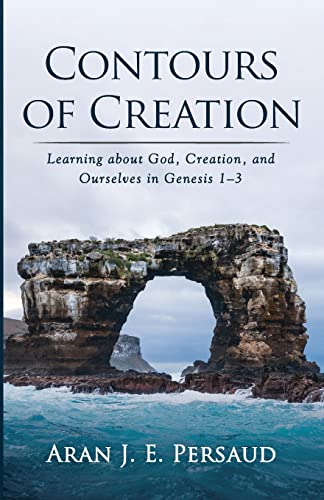
Contours of Creation: Learning About God, Creation, and Ourselves in Genesis 1–3
Written by Aran J. E. Persaud Reviewed By Frank Z. KovácsAlthough the author wrote this book primarily for a general readership confronted with uncertainties about the Bible’s historical reliability, the book’s purpose extends to include the question of human identity and its role in light of the Genesis creation story. The main argument of the book answers the reliability and teleological challenge by advocating a faith-based historical reading of Genesis, that is, “When people live in response to God in love, obedience, and worship regardless of their circumstances, they are living in faith” (p. 2). In this respect, the book is not an apologetic argument against the science of evolution nor does it attempt to harmonize faith and science. It calls the reader to re-evaluate naturalistic ideology and espouse a tradition-based view of history and to see the central role of Genesis 1–2 as a description of humanity’s moral condition, of the causes of that condition, and as a preview of the redemption that God offers in Christ, enabling individuals to fulfil the mandate for which God created them.
The book is divided into twelve short chapters with the introduction being the longest, comprising a quarter of the book. The author argues in the introduction that the ideology of a Kantian closed-world system is limited and subjective and is unable to adequately explain human morality and its metaphysical curiosity. However, the Genesis story read from a faith-centered perspective satisfactorily explains the recorded events and is able to account for these human features since it assumes the existence of an underlying historical reality and an authorial ideology characterized by a moral and spiritual basis of the universe. As a result, a faith-centered reading helps us understand the meaning of God’s acts in history as they relate to readers today.
Chapter 2 discusses the nature of the connection between creation and God its creator in terms of its bond, duration, universal relevance, and the revelation of God’s “tri-personal nature” (p. 36), whose dimensions are expanded in redemption and restoration. Chapter 3 relates the functional ontology of ancient Near Eastern myths to readers’ perception of the Genesis creation story and therefore argues that, on the basis of God’s creative word, chaos was subjected, and creation, with its purpose, must be seen in relation to the source of its existence. This is why, in chapter 4, the use of poetry and prose are able to describe God in creation, “a holistic spiritual and physical world together” (p. 51), beyond the scope of the closed world methodology of modern science. Chapters 5–7 respectively discuss the intentionality, personalness, and communication of God’s creative speech, the attribute of God’s glory as light overflowing to the work of his creation, and the sustaining activity or continuance of God’s creative decrees. In chapter 8, the author reminds readers that, according to God, his creation was good, which is an expression of his sustaining providence to be enjoyed by humans. Continuing these thoughts, chapter 9 argues that the goodness in the creation of Adam and Eve is that humans are image bearers of God with the mandate to reflect God’s qualities as revealed in creation, that is, to rule, as God is king and ruler over creation. Unfortunately, as chapter 10 relates, sin has corrupted human nature and produced a distorted understanding of creation such that humankind’s moral autonomy has sullied the God-given mandate. The force of the book culminates in chapter 11, which argues for the restoration of creation and the restoration of the image of God in humankind by the triune God. Chapter 12 is a very brief recapitulation with some final thoughts.
The brevity of this book is countered with the density of thought-provoking information presented in a readable and colloquial manner. As a consequence, the book could have benefited from added chapter structure to guide the reader, and at certain points further explanations tying together ideas with better precision would have been welcome. The book is a good complement to other works advocating for a tradition-based reading of Genesis since it highlights the inescapable moral and spiritual dimensions of creation.
The content of the book is relevant, and the main thoughts flow together from beginning to end. A noteworthy criticism, however, is the unclear implication of the inference in chapter 3, that in the beginning of creation God organized chaos with humanity in mind (pp. 46–47). This idea of organization, that God established order in creation, which reveals his glory, is not clearly carried through to the idea of justice in the mandate of humanity (p. 97) since only social justice is discussed (pp. 90, 99) and not the resultant overall justice that includes the environment of creation. The earth cries out precisely because we are not being our brother’s keeper as the organization of God intends in creation. This therefore raises the question, “What exactly does reflecting God’s image and ruling over creation mean?” Notwithstanding these queries, the book admirably marshals a biblical-theological/redemptive-historical understanding of Genesis 1–2, suited for readers in a variety of contexts.
In short, the grounding of the author’s thought in the historicity of the Genesis creation story, in the living God as the architect/sustainer of creation, which has relevant metaphysical implications for contemporary humanity, and the combining of these with an accessible dialogue, with the philosophical moorings and ideological inadequacies about creation in a post-Christian society, has allowed the author’s message to find a strong re-voicing of the creation account’s significance and a redolent calling of individuals to reconcile with the Creator God in Christ Jesus.
Frank Z. Kovács
Haddington House School of Theology
Other Articles in this Issue
Menzies responds to Tupamahu’s post-colonial critique of the Pentecostal reading of Acts and the missionary enterprise...
The Lamblike Servant: The Function of John’s Use of the OT for Understanding Jesus’s Death
by David V. ChristensenIn this article, I argue that John provides a window into the mechanics of how Jesus’s death saves, and this window is his use of the OT...
Geerhardus Vos: His Biblical-Theological Method and a Biblical Theology of Gender
by Andreas J. KöstenbergerThis article seeks to construct a biblical theology of gender based on Geerhardus Vos’s magisterial Biblical Theology...
Is the One God of the Old Testament and Judaism Exactly the Same God as the Trinitarian God—Father, Son, and Holy Spirit—of the New Testament and Christian Creeds?
by John Jefferson DavisThis article argues that the One God of the Old Testament and Judaism is exactly the same God as the Trinitarian God of the New Testament and Christian creeds...
A well-known Christian intellectual and cultural commentator, John Stonestreet, has often publicly spoken of the need for Christians to develop a theology of “getting fired...
Other Reviews in this Issue