
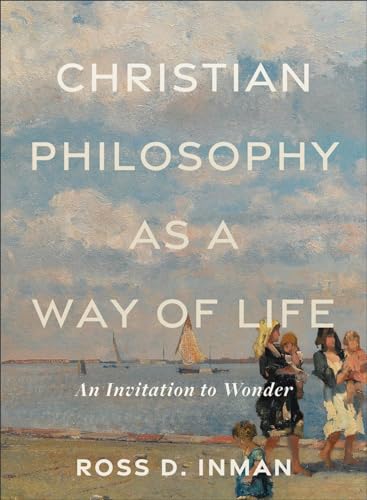
Christian Philosophy as a Way of Life: An Invitation to Wonder
Written by Ross D. Inman Reviewed By Mark StephensMore than two decades ago I meandered into philosophy at a secular university. I had started as a psychology major but could not shake the intuition that I was not able to help someone heal as a person if we never talked about what a person is. None of my friends and family ever spoke against my decision. Nevertheless, I still sensed that, for some, the entire discipline of philosophy was regarded as impractical, a distraction, and potentially dangerous to my spiritual health.
Ross Inman’s Christian Philosophy as a Way of Life is written for just such circumstances and to counter such misunderstandings. As a teacher of philosophy in a theological seminary, he well knows the standard canards about philosophy’s impracticality and impenetrability. Accordingly, Inman’s goal is to argue that philosophy is essential to a “human life well lived” (p. 113).
As gestured in the subtitle, Inman grounds his defense of philosophy in the human capacity to wonder. Drawing first from the insights of psychology, Inman posits that regular experiences of awe and wonder are profoundly beneficial, humbling the soul and drawing the self outward into engagement with the reality we inhabit (ch. 1).
From there Inman advances that philosophy constitutes a uniquely human practice for fostering wonder about reality and appropriate wisdom for living within it (ch. 2). Humans are, by definition, “meaning-seeking animals” (p. 18), who not only want but need to make sense of it all. Philosophizing is a design feature, not a bug. Indeed, philosophy is a crucial tool for enabling us to understand what the world is, and what the world should be. For the Christian, such philosophizing is entirely illuminated and completed by the “radiance and light of God in Christ” (p. 24). The ultimate wonder which drives philosophy is the contemplation of a wondrous Creator, whose glory, goodness, and beauty shine through all of creation.
Chapters 3–4 move us from wonder to wisdom. Inman examines the claim that philosophy is impractical by replying that good philosophy has always been intimately tied to the practices of everyday life. With the help of Pierre Hadot, Inman contends for the wisdom of Greco-Roman tradition of philosophy (Plato, Aristotle, Epictetus, Plutarch, and Seneca), wisdom which can heal us by disciplining our minds to both see truly and live well (ch. 3). For Inman, this practical and therapeutic approach to philosophy finds its consummation in Christian philosophy. Through the grace of Christ, the philosophical quest of the ancients is fully satisfied. In Christ, we can see the world truly, and can find the empowerment to live accordingly. Crucial to Inman’s approach is that good philosophy requires regular practices, a fact the Greeks and Romans recognized. But for the Christian, the practices of philosophy are necessarily spiritual exercises (ch. 4).
Having argued that philosophy is for wonder and wisdom, Inman moves to consider how it might address our contemporary “existential ailments” (ch. 5). These include our Promethean desires to master the world, and over-saturated minds that can no longer perceive well because they are filled with meaningless junk. Christian Scripture steps into this existential malaise, providing us with the fundamental truth about ourselves: that we are finite and sinful creatures (contra Prometheus) and that a core feature of new life in Christ is disciplined attention to the renewing of our minds (ch. 6). For the latter, the specific practices of solitude, silence, self-examination, and meditation are vital. But these disciplined remedies for our ailments do not terminate with the individual. They ultimately lead us to spiritual friendships, relationships of virtue where we commit to the well-being of others through intentional philosophizing together.
The final four chapters (chs. 7–10) work together as an integrated whole, both reiterating and extending what has already been said. Inman knows that the popular-level problem with philosophy remains the belief that it is impractical and unproductive. But Inman points out that such criticism assumes a particular understanding of productivity, where what really matters for human flourishing is economic output. But this is to adopt a materialist, rather than a Christian, anthropology. If human beings are made not just for money and stuff but instead for the truth, beauty, and goodness of their Creator, then philosophy is necessarily valuable and practical, because it guides and shapes the human self towards that which is “ultimately worth pursuing” (p. 127). Such words need to be addressed not only to non-Christians, but also to Christians, for even our visions of “practical” discipleship easily eschew the intrinsic value of truth, beauty, and goodness for merely instrumental “results” (be it church attendance, giving campaigns, or whatever other metric might take our fancy). To counter this tendency, Inman draws deeply from both Scripture and Christian tradition to promote the intrinsic value of a contemplative life. But contrary to some approaches to contemplation, Inman posits that philosophy is crucial to the enterprise.
Inman’s book is a most helpful word in a context of shallow distraction and pragmatism. It functions as something of a prolegomenon to the study of philosophy, an “invitation” as the book’s subtitle announces. If we ever needed reminding that the life of the mind matters to God, this book amply displays it. In particular Inman demonstrates the wealth to be discovered in the thinkers of late antiquity and the medieval world. This is at once both the book’s greatest strength, and perhaps also its greatest weakness. With some notable exceptions, such as the German Catholic philosopher Josef Pieper, Inman draws far less upon the insights of thinkers from the last 400 years. Indeed, early in the book Inman commends “an older vision of philosophy as a way of life” (p. 2). As much as modern and postmodern philosophies have their problems, the thought that the best Christian philosophy is mostly found in “classic” texts could be regarded as reverse chronological snobbery.
A somewhat related criticism would be the conceptual, and even practical, distinction between philosophy and theology. Are they versions of the same thing? Is philosophy a sub-discipline within theology? Inman cites historical examples where philosophy was helpful in leading a person to God, such as Cicero’s work Ηortensius in the conversion of Augustine (pp. 169–70). But strictly speaking, is philosophy necessary if one is already studying theology? Inman points to the example of Aquinas as one who saw theology and philosophy as complementary paths to “the vision of God” (p. 159). But the distinct categories and associated practices that are native to philosophy, in particular questions of epistemology and logical argumentation, do not appear much within this volume. For that one might seek to consult the recent work of Dolores Morris (Believing Philosophy: A Guide to Becoming a Christian Philosopher [Grand Rapids: Zondervan Academic, 2021]) as an alternative starting point.
These critiques aside, Inman has produced a work that will serve a wide audience. It will be particularly useful for tertiary students, as they seek to appreciate and integrate philosophy into their wider learning. But it would also function well as something that could be used in small groups within churches, particularly for those who desire to think more clearly and coherently about their faith.
Mark Stephens
Sydney Missionary & Bible College
Croydon, New South Wales, Australia
Other Articles in this Issue
Editorial: Announcing the Carson Center for Theological Renewal
by Brian J. Tabb and Benjamin L. Gladd
A Change in Kind, Not Degree: Labels, Identity, and an Evaluation of “Baptistic Congregationalists”
by Nathan ShermanHow do we decide what to label people of centuries past when they had no clear labels for themselves? Should we describe seventeenth century Baptists as “Baptists” if that was not what they called themselves? Matthew Bingham has recently argued that instead of using the label “Particular Baptists” for the English Calvinistic Baptists of the 1640s and 50s, historians would more clearly describe their subjects as “baptistic congregationalists...
Filial Revelation and Filial Responsibility: (Dis)obedient Sonship and The Religious Leaders in Matthew 11–16
by Adam FriendSonship appears in every section, at every turning point, and on the lips of every character in Matthew’s Gospel...
This paper articulates a provisional thesis, namely, that we need a pedagogical category within our biblical theological frameworks, on the basis that such a category was in the New Testament authors’ minds...
Scholars disagree about the precise nature of the sin that provokes God’s wrath in Genesis 19...
Other Reviews in this Issue