
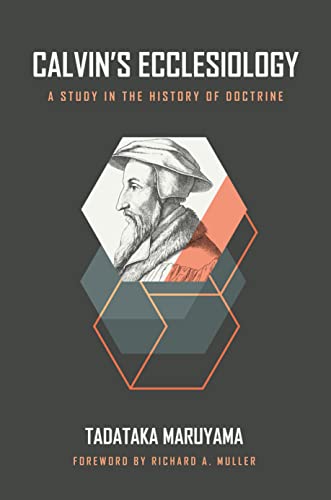
Calvin’s Ecclesiology: A Study in the History of Doctrine
Written by Tadataka Maruyama Reviewed By A. T. B. McGowanTadataka Maruyama was formerly president and professor of Church History at Tokyo Christian University. His interest in ecclesiology formed the bookends of his academic career. At the beginning, he wrote his dissertation on Beza’s ecclesiology, later published as The Ecclesiology of Theodore Beza: The Reform of the True Church, Travaux d’Humanisme et Renaissance 166 (Geneva: Librairie Droz, 1978). Now, in retirement, he has turned his attention to Calvin’s ecclesiology. This book is highly praised by Richard Muller in the Foreword, where he says that “Maruyama’s work is a masterful account of the early Reformation context and its impact on Calvin as well as Calvin’s impact on the shaping of a Reformation ecclesiology in Geneva and beyond.” That commendation alone should make it clear that this is not a light read for the casual student but rather a substantial volume that scholars of the Reformation, in general, and of Calvin, in particular, will find illuminating and instructive. It stands in marked contrast to those who have sought to expound Calvin’s ecclesiology simply by stringing together quotations from The Institutes (with no historical or theological context) or those who have approached the subject to prove some point or other, for example, that Calvin’s view is identical to that of the writer’s own particular confessional position.
The subtitle of Maruyama’s book is “A Study in the History of Doctrine,” and it is this historical approach that makes the book so valuable. The author is a master of both primary and secondary sources, not only in Calvin studies but also in the wider fields of historical, philosophical, and sociological studies of 16th-century Europe. For this reason, he is able to set Calvin’s teaching in its context and, for the same reason, is able to identify development in Calvin’s thinking, from what he calls his “Catholic” ecclesiology to a “Reformed” ecclesiology and then finally to a “Reformational” ecclesiology.
Despite the length of the book (473 pages), it consists of only four chapters. In chapter 1, “Academic Formation and Catholic Ecclesiology,” Maruyama describes the earliest period in Calvin’s life and thought, including his studies in humanities, law, and the classics, leading to the publication of his commentary on Seneca’s De Clementia. Calvin’s “sudden conversion” is described and analyzed, as is his involvement with the different strands of French evangelical humanism, leading to the Placards Affair and his exile in Basel. It is fascinating to see how these events and others impacted Calvin’s writing, not least his ecclesiology. Maruyama identifies the writing of the first version of The Institutes as significant in forming what he calls Calvin’s Catholic ecclesiology. He notes, “His Catholic ecclesiology comprehended the church as the people of God or Christ in the entire scope of salvation history, from God’s creation, the fall and redemption, the gospel and to the end of times” (p. 48). The remainder of the chapter is spent in a detailed analysis of what The Institutes has to say in relation to ecclesiology and related subjects while always bringing other Reformational documents to bear on the analysis.
In chapter 2, “The Early Genevan Reformation and Practice of Catholic Ecclesiology,” the author shows how Calvin put into practice the ecclesiology that he had been developing through his study and writing. One of the strengths of this chapter is the detailed study of both Lefèvre and his disciple, Farel. Maruyama believes that Farel’s significance in Geneva, while noted, has often been underestimated. Indeed, he argues persuasively that two of the three key documents in the Genevan Reformation (the Confession and the Articles) were written by Farel rather than by Calvin, to whom they are normally ascribed. He concludes that “[Calvin’s] first Genevan period was a testing time for his biblicism and activism as well as a formative period upon which the future formation of his Reformed ecclesiology and Reformation ecclesiology was made possible” (p. 224).
Chapter 3, “The Strasbourg Period and a Transition to New Ecclesiologies,” deals with Calvin’s exile from Geneva and his three-year stay in Strasbourg. This was an instructive and productive period in Calvin’s life and work, the main achievements being the revised second edition of The Institutes, his Commentary on Romans (1540), and the 1541 French edition of The Institutes. As Maruyama notes, Calvin’s work as a pastor to French exiles was greatly assisted by the Bible, catechisms, hymnals, other religious literature, and The Institutes, all being available in the French language. One strength of this chapter is its analysis of the theology and practice of Martin Bucer, the great Reformer of Strasbourg. It describes his relationship with Erasmus and the Anabaptists, and it discusses his work in writing the XVI Articles, the Ecclesiastical Ordinances, and the Disciplinary Ordinances. As well as providing a basis for the life of the church in Strasbourg, these documents also help us understand Bucer’s ecclesiology. In this regard, Marayuma offers a significant pushback on the “Bucer’s influence” theory, namely, that Bucer’s influence on Calvin was the most significant element in determining Calvin’s ecclesiology. Various evidence and examples are given to undermine this theory, affirming that Calvin was his own man.
The fourth and final chapter, “Reformed ecclesiology and Reformation ecclesiology,” describes Calvin’s “Reformed ecclesiology” and his “Reformation ecclesiology” in the context of his work as the Reformer of Geneva and his wider influence on the Reformed church and Reformed theology. “Reformed ecclesiology” means the “form” of the Protestant church as contrasted with the Roman Catholic Church, as formulated in the 1543 version of The Institutes and expounded in Calvin’s First Corinthians Commentary. “Reformation ecclesiology” is the final form of Calvin’s ecclesiology, which was developed in the latter part of his time in Geneva but also through the wider context of the French Reformation and his involvement in the Reformation throughout Europe. In order to demonstrate this “Reformation ecclesiology,” Marayuma engages in a detailed study of Calvin’s exegetical works, indicating the changes and developments in Calvin’s ecclesiology between 1543 and the final 1559 edition of The Institutes.
This book is not only an essential tool for Calvin scholars but also a methodological primer on how to study theology by setting any theology in its context, observing the development of that theology over time, and taking account of circumstances, events, and the work of other scholars. It highlights the importance of engaging with all available literature.
A. T. B. McGowan
A. T. B. McGowan
University of the Highlands and Islands
Inverness, Scotland, UK
Other Articles in this Issue
Menzies responds to Tupamahu’s post-colonial critique of the Pentecostal reading of Acts and the missionary enterprise...
The Lamblike Servant: The Function of John’s Use of the OT for Understanding Jesus’s Death
by David V. ChristensenIn this article, I argue that John provides a window into the mechanics of how Jesus’s death saves, and this window is his use of the OT...
Geerhardus Vos: His Biblical-Theological Method and a Biblical Theology of Gender
by Andreas J. KöstenbergerThis article seeks to construct a biblical theology of gender based on Geerhardus Vos’s magisterial Biblical Theology...
Is the One God of the Old Testament and Judaism Exactly the Same God as the Trinitarian God—Father, Son, and Holy Spirit—of the New Testament and Christian Creeds?
by John Jefferson DavisThis article argues that the One God of the Old Testament and Judaism is exactly the same God as the Trinitarian God of the New Testament and Christian creeds...
A well-known Christian intellectual and cultural commentator, John Stonestreet, has often publicly spoken of the need for Christians to develop a theology of “getting fired...
Other Reviews in this Issue