
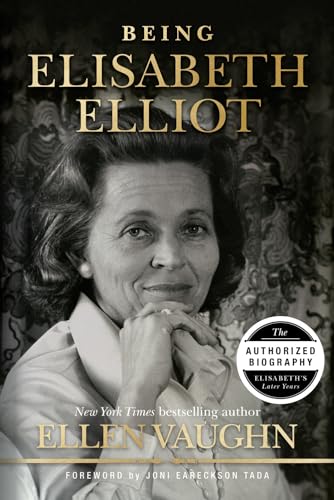
Being Elisabeth Elliot
Written by Ellen Vaughn Reviewed By Karin Spiecker StetinaAs a missionary to the Auca Indians, the wife of martyred Jim Elliot, and a prolific Christian author, Elisabeth Elliot has inspired many Christians with her desire “to live a life of reckless abandon for the Lord” (Through Gates of Splendor: The Martyrdom of Five American Missionaries in the Ecuador Jungle [New York: Harper & Brothers, 1958], p. 5). Should Elisabeth Elliot, however, be put on a pedestal as an Evangelical hero? In her second authorized biography, Being Elisabeth, Ellen Vaughn continues to explore Elliot’s life with this question in mind. Vaughn, an acclaimed novelist and biographer known for her engaging, well-researched narratives on prominent figures such as Sarah Palin and Chuck Colson, informs the reader that her guiding principle in writing Elisabeth’s story is to “tell the truth, in love,” believing, like Elisabeth Elliot did, that “flawed and relatable protagonists showcase the supernatural power of God” (p. 9). It is debatable whether she fully accomplishes her goal.
In contrast to Lucy S. R. Austen, author of Elisabeth Elliot: A Life (Wheaton, IL: Crossway, 2023), who only relied on public documents, Vaughn utilized Elliot’s journals and personal papers provided for her by the Elisabeth Elliot Foundation. These sources give a unique glimpse into Elisabeth’s private thoughts and feelings, which, at times, can be startling and even provocative. This biography seeks to reveal who Elisabeth Elliot was after leaving the mission field rather than describe her life, work, and influence. Vaughn’s work challenges an overly simplistic picture of Elisabeth Elliot as a saintly missionary and a bastion of conservative ideology by revealing a more complex, relatable Christian woman striving to live out her faith amidst incredible grief, doubts, and everyday challenges. In this book, the author explores the fundamental questions that plagued Elisabeth, such as what it fundamentally means to be human, how one follows Christ in a secular culture, how one faithfully serves God when life is hard, and how a woman can rely on God when experiencing loneliness or rejection.
In her earlier work, Becoming Elisabeth Elliot (Nashville: Broadman & Holman, 2020), Vaughn chronicles Elisabeth’s transition from “a young woman who dealt in ‘certainties’ to the older woman who dealt, far too often, in the realm of uncertainties” (p. 5). In Being Elisabeth Elliot, Vaughn examines her life of “uncertainty” after she returns to the States with her daughter Val and her desire to trust and lean into “the good and holy character of God, His redeeming love, and merciful faithfulness” (p. 5). This book, with a foreword written by Joni Eareckson Tada, is divided into three sections— “Bedrock,” “Being,” and “Believing”—and subdivided into 38 short chapters and an epilogue. The bulk of the chapters focus on the second part, “Being,” particularly her life as a widow, her second “miraculous” marriage to Addison Leitch, her gut-wrenching experience of watching Leitch die of cancer, and her second season of widowhood. Vaughn includes very little about Elliot’s final 38 years and her third marriage to Lars Gren. This may be partly due to the lack of access to personal documents from this period (reportedly, Gren destroyed most of the journals written during their marriage).
As Vaughn warns, “If you want the expected version of Elisabeth Elliot’s story, don’t read this book” (p. 9). Given that this biography is primarily based on Elisabeth’s private journals, there are surprising and, at times, alarming details and less-than-glamorous glimpses into her heart, mind, beliefs, and interests. This is especially evident in the specifics relayed about her three marriages, her friendships, and her struggle to find her place in conservative Christian circles. Vaughn is indisputably an engaging writer; however, her authorial intrusion into Elisabeth’s story is somewhat surprising. This is evidenced in the author’s long digression about her own husband’s cancer journey, as well as the interjection of her opinions on some of Elisabeth’s views and choices, including Elisabeth’s decision to marry and stay with her third husband.
In her attempt to tell “the truth in love,” Vaughn includes some gratuitous details that may be better kept in personal journals (such as information about her romantic relationship with Leitch, her negative opinions of others, and defamatory statements about her husbands). While the author reveals how Elliot’s “legacy” of “brokenness and need for Christ highlights His eternal, golden mercies” (p. 11), her story could have been told more delicately. There are reasons why Elisabeth kept her journals to herself. Some of the emotions that Elisabeth records, as is the case with all journals, may not accurately represent her enduring thoughts, feelings, or situations. The beginning is a bit tedious and difficult to follow due to the long sections of historical details and the inclusion of long sections of Elisabeth’s journals. While her ability to provide information about the context gives a picture of how Elisabeth was shaped by and responded to her circumstances, some of the background information strays a bit from Elisabeth’s story. There are some minor errors in the text, such as misspelled names, and uneven writing styles that seem to move randomly between informative, personal, and narrative commentary. Reading Austen’s biography of Elliot alongside Vaughn’s might help give a fuller picture of both the public and private Christian woman.
Overall, this biography is an important addition to works on Elisabeth Elliot, particularly for evangelical Christian women who want to know more about her interior life. As Tada rightly says and this work reveals, “Our hero of the faith was not a bronze statue, impervious to fissures; nor was she an airbrushed paragon of virtue, untested by the things that thwart and frustrate us all … but with any hero worth her weight, she would set people straight who idolized her, pointing them only to the hero who will never let them down, Jesus Christ” (p. xii). The very last page points the reader to the mission of the Elisabeth Elliot Foundation, which supported the writing of this biography: “Hope in Suffering, Restoration in Conflict, and Joy and Obedience to the Lord Jesus Christ.” Vaughn’s biography points to this as the key to Elisabeth’s life and ministry.
Karin Spiecker Stetina
Karin Spiecker Stetina
Talbot School of Theology
La Mirada, California, USA
Other Articles in this Issue
The Spirit of God and the Religions of the World: A Response to Amos Yong’s Claims
by J. David WilloughbyAmos Yong, an acclaimed Pentecostal scholar, argues for what he calls a pneumatological theology of religions...
Pastoral Pensées: “We Do Not Lose Heart”: Theological Encouragement for Endurance and Opportunities for Reflection from 2 Corinthians 4:1–16
by Cody WilbanksBurnout is an evergreen threat for those in Christian ministry...
Contraception and the Church: Making Sense of the Debate and Some Pastoral Advice
by Dennis M. SullivanThis article reviews the ethical and theological issues surrounding birth control, with an emphasis on hormonal methods...
“Union” has become an increasingly valuable tool in discussions of atonement and soteriology...
Other Reviews in this Issue