
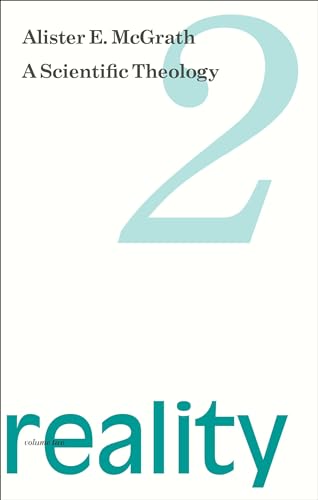
A SCIENTIFIC THEOLOGY VOLUMES 1 AND 2
Written by Alister McGrath Reviewed By Steve BishopAlister McGrath needs no introduction to readers of Themelios. He is one of the most prolific and thoughtful of contemporary theologians, producing popular and academic books. The two academic books under review here are the first two of a three part volume entitled: A Scientific Theology. The aim of which is ‘to explore the interface between Christian theology and the natural sciences, on the assumption that this engagement is necessary, proper, legitimate and productive’ (Nature p. xvii). McGrath is well equipped to perform such a task as has doctorates in biology and in theology.
Volume 1 Nature begins with a discussions on the legitimacy of a scientific theology (ch. 1), moves onto a discussion of the approached adopted (ch. 2), before examining the concept of nature (ch. 3). McGrath argues persuasively that nature is a socially argues persuasively that nature is a socially mediated construction. One helpful by-product of this chapter is the critique of Willem Drees’ naturalism, as McGrath states Drees fails to answer the crucial question ‘How do we know that the real is only the natural?’ (129). Naturalism is self-defeating, ‘a naturalist cannot coherently assert the naturalist thesis’ (131). In chapter 4 he examines the Christian doctrine of creation drawing upon and discussing Pannenberg, Michael Foster, Aquinas, Calvin, Barth and Tom Torrance.
The implications of a Christian doctrine of creation are scrutinised in chapter 5. Then in the final chapter the issue of the place of natural theology is examined. This for me was the most stimulating part of the first volume. He sees the purpose of natural theology not to prove the existence of God, but rather to reinforce the plausibility of belief in God.
In the second volume Reality he appropriates Roy Bhaskar’s critical realism. Bhaskar’s approach supplies three helpful insights: a stratified view of reality; methodology is consequent upon ontology; and epistemology does not determine ontology. McGrath rightly notes that Bhaskar is not the first to posit this view, Polanyi did so in his Tacit Dimension, what is surprising is that McGrath makes no mention of the Dutch Christian philosopher Herman Dooyeweerd. Dooyeweerd—see for example his New Critique—is well known for advocating a multi-layered view of reality, which I would suggest is more fruitful than Bhasker’s stratification approach.
Most engaged in the science-theology debate take critical realism as axiomatic (e.g. Peacocke, Barbour and Polkinghorne), in chapter 9 McGrath provides a thorough defence of it. He examines three rivals: idealism, positivism and instrumentalism and shows why they fail to convince. He also examines the postmodern retreat from reality and the strong programme’s denial of any external reality. Both are found wanting.
Some of the many strengths of McGrath’s approach are that he takes postmodernism and mathematics seriously. Mathematics is neglected too often in the science-theology literature and postmodernism is time and again dismissed as being irrelevant. McGrath avoids the trap of equating postmodernism with relativism; he tackles head on the postmodern critique of science and realism and he finds: ‘Postmodernity has defeated itself by deploying weapons that could be used more effectively against it than support it’ (vol. 2, p. 192).
In the opening paragraph of Nature he comments: ‘This series of volume is not intended to offer some definitive statements concerning the relations of Christian theology and the natural sciences, but to offer some suggestions which will stimulate discussion, even if they do not command assent’. In these first two volumes he has certainly done that! McGrath has produced a book that makes for compelling and stimulating reading; it should be compulsory for all those who want to interact with the science-religion debate. Though those coming fresh to the subject may find McGrath’s The Foundation of Dialogue in Science and Religion (Blackwell, Oxford, 1988) more accessible. I look forward to the final volume of this thought-provoking trilogy due out in autumn 2003.
Steve Bishop
Bristol
Other Reviews in this Issue