
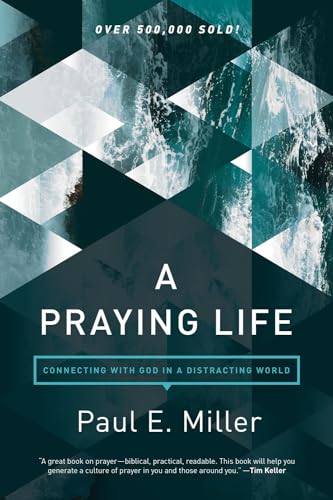
A Praying Life: Connecting with God in a Distracting World
Written by Paul E. Miller Reviewed By Rhett DodsonBooks on prayer should be a welcome addition to any Christian’s library, and none more so than A Praying Life. In a fallen world, prayer seems unnatural because of our pride and useless because of our cynicism. We need help, and Paul Miller, co-founder (with his father, Dr. Jack Miller) of World Harvest Mission and current executive director of seejesus.net, offers that help with biblical wisdom and insight to the human heart. Miller’s new book is a great companion for anyone who desires to grow spiritually in a life of prayer. The subtitle of the book, Connecting with God in a Distracting World, is just what the author helps the reader to do.
Unlike many books that take the reader through the facets of prayer (thanksgiving, intercession, waiting, confession, etc.), Miller starts where we start, as children struggling to get our requests before God. Through thirty-two chapters divided into five parts, Miller takes the reader from his first unsteady steps and stammering words in prayer through the darkness of cynicism, and into the joy of asking God anything! Miller stresses the personal, Father-child relationship in prayer. In light of this emphasis, he writes, “Consequently, prayer is not the center of this book. Getting to know a person, God, is the center” (p. 20).
In the fourth part of the book, Miller shows us that our prayers are part of a bigger story, God’s story, a story in which prayer plays a significant role. If A Praying Life is anything, it is practical, and the fifth section of the book surveys several tools such as prayer-cards and a prayer-journal that help to make prayer a vital part of your everyday life. A Praying Life breaths the thick air of reality. The author peppers the entire book with personal stories of trials, doubts, struggles, and wonderful answers to prayer, especially regarding his autistic daughter, Kim. Miller is unafraid to bear his soul, and I found his transparency fresh and challenging.
Miller is at his best when dealing with the insidious nature of cynicism. The following quotations from the chapter “Following Jesus out of Cynicism” provide a sample of the scriptural wisdom he offers: “Jesus keeps in tension wariness about evil with a robust confidence in the goodness of his Father” (p. 83). “The feel of a praying life is cautious optimism—caution because of the Fall, optimism because of redemption” (p. 84). “Hope begins with the heart of God. As you grasp what the Father’s heart is like, how he loves to give, then prayer will begin to feel completely natural to you” (p. 85).
Miller also grapples with the hard reality of praying and praying and yet seeing no answers. But from the hardships he has faced come gems like this: “When God seems silent and our prayers go unanswered, the overwhelming temptation is to leave the story—to walk out of the desert and attempt to create a normal life. But when we persist in a spiritual vacuum, when we hang in there during ambiguity, we get to know God. In fact, that is how intimacy grows in all close relationships” (p. 192).
While I appreciate A Praying Life very much, two issues concern me. Following what appears to be a trend in evangelical writings on spirituality, Miller quotes approvingly from Roman Catholic and Greek Orthodox authors. Generally the quotations in themselves are innocuous, but as Donald Whitney has demonstrated, one can write about the disciplines of the Christian life and find plenty of quotable materials in the Reformers, Puritans, and evangelical authors. These quotations effectively point the hungry reader to more substantial food.
Second, in an endnote discussing Philippians 2 and the kenosis of Christ, Miller writes, “We do not know how or to what extent Jesus was emptied of his divinity” (p. 272n2). Jesus emptied himself by taking the form of a servant. He was never emptied of any of his divinity, though aspects of it were veiled. I assume Miller believes this as well, and hopefully revisions of the book will correct this error.
If you want to grow in your knowledge of God and find help for a richer life of prayer, read this book. In spite of these two criticisms, it is one of the best works on prayer I have ever read.
Rhett Dodson
Grace Presbyterian Church (PCA)
Hudson, Ohio, USA
Other Articles in this Issue
We begin with a question of translation. Many translations place a period after the word “conviction” in 1 Thess 1:5: “in power and in the Holy Spirit and with full conviction...
The Inexhaustible Fountain of All Good Things: Union with Christ in Calvin on Ephesians
by Lee GatissJuly 10, 2009 was the 500th birthday of the acclaimed French Reformer John Calvin...
The name of Martin Luther is perpetually linked to the doctrine of justification by faith alone...
Of the many questions currently surrounding the discussion about justification, the relationship between justification and spiritual fruit merits attention...
Every year a few students ask me my thoughts about whether they should pursue doctoral studies and I respond with what has come to be known as ‘The Speech...
Other Reviews in this Issue