
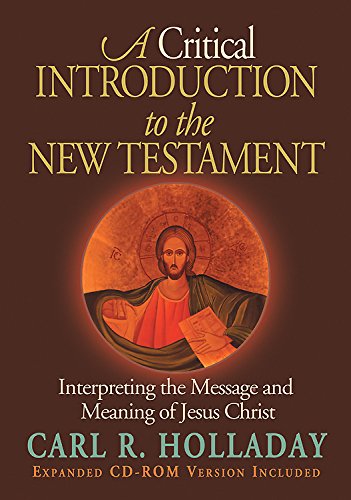
A CRITICAL INTRODUCTION TO THE NEW TESTAMENT: INTERPRETING THE MESSAGE AND MEANING OF JESUS CHRIST
Written by CARL R. HOLLADAY Reviewed By Lee S. BondThe purpose of this introduction is to provide the reader with basic theological, historical, and literary information on the twenty-seven writings of the NT. This monograph is the culmination of professor Holladay’s thirty years of experience teaching the NT to seminary and college students.
The book includes material found in traditional NT introductions. The familiar “W’s” are all explored: Who wrote each letter? When? Where? To Whom? Why? However, the distinctive feature of this NT introduction is that Holladay gives greater attention to the social, theological, ethical, and religious dimensions related to the message and meaning of Jesus Christ. Moreover, Holladay explores how the earliest believers interpreted this message. The monograph also gives an overview of how the NT has been read and interpreted throughout the last twenty centuries.
Regarding structure, Holladay treats the writings of the NT in the order in which they appear in modern day Bibles. An added plus is that the book comes in two formats, a 600 page print edition and an expanded CD-ROM version containing a 900 page PDF-based text. The standard print edition contains introductory material that is informative and interesting. The CD-ROM version on the other hand takes the topics to a deeper level and covers them in more detail. The basic bibliographies found at the end of each chapter are supplemented by lengthy annotated ones in the e-version. Holladay also provides helpful evaluations of resources that were used in the writing of the book. The monograph also contains helpful sections on the history of study which may benefit a variety of students. Moreover, the e-version comes with additional diagrams, illustrations, and maps not found in the print edition. In terms of structure, the e-version does have an index that is designed to help readers do simple searches. One can perform a full-text search within individual chapters and print a page or specific set of pages from selected sections.
The book is a valuable resource for students, teachers, and pastors, and I applaud Holladay for his effort. However, the weaker side of this introduction is, naturally enough, the e-version. While Abingdon Press has made a step in the right direction in putting the book in digital format, the e-format which they have chosen has two main weaknesses: research capabilities and user interface.
First, while it is possible to save all twenty eight individual chapters of Holladay’s book onto a computer hard drive, the basic search engine works only with the CD-Rom version and is limited to the topics found only in the print version. So, if one wanted to find every place where Holliday discusses a biblical passage, modern author, specific topic, or church father, he or she would have to read the footnotes of each individual chapter because this material is not indexed or hot linked to the search engine. It is the opinion of this reviewer that the e-version was not intended to be a research tool.
Secondly, the PDF-based text is more difficult to work with in the teaching and preaching setting. Holladay has provided instructors and pastors with excellent maps, tables, and visual aids. However, it is not easy to transfer PDF-based material into another program like MS Power Point or MS Word.
In short, the book is a welcomed edition to NT introductions and those who enjoy reading print editions might seriously think about adding this one to their collections. But to those who enjoy digital libraries, I would suggest waiting until improvements can be made to the e-version.
Lee S. Bond
Trinity Evangelical Divinity School
Deerfield, Illinois, USA
Other Articles in this Issue
One of the most eminent spin doctors of the fourth century, Augustine bemoaned that he was merely a vendito verborum (a peddler of words)...
Hudson Community Chapel is a suburban church in the Midwest that averages a little over three thousand people each weekend...
It must by now be questionable whether the word "mission"retains any residual value for missiology...
"For to freedom you yourselves were called, brothers; only do not use your freedom as an opportunity for the flesh, but through love serve one another...
In the course of Christian history, nowhere has the tension between the teachings of Jesus and valid application of those teachings in postbiblical socio-cultural circumstances manifested itself more clearly than surrounding the issue of violence...
Other Reviews in this Issue