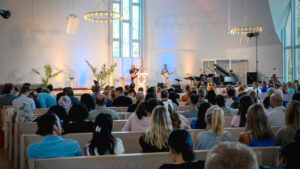

My youth pastor used to say of our Wednesday night worship services: “This is not a concert!” And his warning was certainly correct and helpful. But I can’t help but think that the sensory experience of our services often stood in contradiction to what my youth pastor was saying. The lights, sounds, and vibe of the room correlated to what many of us would identify plainly as a concert. But it wasn’t a concert. Right?
It’s complicated.
On one hand we know corporate worship—particularly congregational singing—is something distinct from a concert or other performed art or entertainment. When the church gathers and sings together, there’s a “set apart-ness,” a qualitative difference from any other kind of gathering or event in which someone, or group of people, is singing.
On the other hand Christians are called to worship God in every facet of their lives (Col. 3:17; Rom. 12:1), seeing our work, for example, as an opportunity to glorify God. What happens when Christians practice the “all of life” worship in their vocation, in part, by leading other Christians in corporate singing?
Enter the awkward position of the worship leader.
Inherently Performative
Worship leaders—that is, musical worship leaders, for the whole gathering is worship—are doing something different from entertaining, but their role entails some elements that are inherently performative: aesthetic sensibilities, technical proficiency, and stage presence. These elements may be obvious or subtle, but they are there, and they have to be dealt with.
Some churches deal with these elements by simplifying song arrangements and musical accompaniment to reduce opportunities for worship leaders to embellish or direct attention to themselves. Other churches, often operating with high production value, see these performative elements as assets to be used in full capacity, with little thought toward what end they’re serving. And most tragically, some worship leaders are blind to the unique power that comes with performance, and their naïveté causes serious harm to others and themselves.
Worship leaders are doing something different from entertaining, but their role entails some elements that are inherently performative.
The word “performance” itself has become a kind of antonym for the word “worship.” In the context of church life, I don’t think I’ve ever heard the word used except as a critique of the way a musician is leading—seeking their own glory instead of God’s. But this is not entirely fair. I think Christian performers, whether in the realm of dance, music, or theater, would be offended at the notion that their performance robs God’s glory and seeks it for themselves. That is certainly a temptation, but any Christian performer who views vocation through a biblical lens recognizes that his or her work is a service to others and an occasion for worship. So what’s the distinction in roles between a godly performer and a godly worship leader?
Distinctive Service
A Christian performer serves people who have chosen to lend a listening ear or an attentive eye (or both). The audience participates by paying attention, and so the performer’s job is to help ensure their attention is well invested. A worship leader, on the other hand, serves people who have been called to sing; the performative elements of his or her job should serve that end.
This doesn’t mean we strip things back to their bare essentials, because that doesn’t always encourage people to sing passionately and wholeheartedly. It also doesn’t mean we give full freedom to our aesthetic sensibilities, technical ability, or stage presence, because that can end up being manipulative or confusing.
Five Ways to Steward Performance
Here are a handful of ways worship leaders can steward their performance to best serve the church.
1. Grow in aesthetic tastes.
Worship leaders should regularly listen to music and engage in art beyond what’s popular in their particular circles. Listen to music that is challenging, intricate, born of a culture outside your own. Listen to music that feels more like a complex, delicious meal than a protein bar or energy drink. The more we grow in this, the more we are filled with wonder that God calls his people to employ the gift of music to worship him—and that we get to be part of leading his people in that response, to the praise of his glorious grace.
2. Grow in technical ability.
If we are called to work wholeheartedly in whatever we do (Col. 3:17), Christians have the greatest reasons to pursue vocational excellence. Worship leaders might find it wasteful to put intentional time into growing their craft, but in God’s eyes, this is time well spent.
Christians have the greatest reasons to pursue vocational excellence.
Worship leaders who grow in aesthetic tastes and technical ability, with the aim of serving God’s people, will have a growing capacity for discernment. They will grow in the ability to choose, arrange, and lead songs in a way that boosts congregational singing, rather than their own ego.
3. Avoid novelty.
There’s a temptation for worship leaders to use their gifts in such a way that they’re perceived as clever, witty, or cutting edge. Steer clear of this temptation.
Novelty masquerades as creativity and beauty, but it’s a cheap replacement. If we’re seeking to point people to the glory and beauty of God, we are shooting ourselves in the foot if we give our churches cheap tricks and amusement.
4. Build a team of musicians from the congregation.
Psalm 150:4 calls God’s people to “praise him with tambourine and dance; praise him with strings and pipe!” In 1 Chronicles 15, as the ark of the covenant is brought to Jerusalem, David “commanded the chiefs of the Levites to appoint their brothers as the singers who should play loudly on musical instruments, on harps and lyres and cymbals, to raise sounds of joy” (v. 16).
The worship of God’s people can and should be led and accompanied by a skilled group of musicians, and the Bible demonstrates that robust musical expression can serve God’s people as they sing. But as we consider worship leading in our churches, the liturgy (literally, “the work of the people”) should be led primarily by the people. It is the work of the congregation, not the work of outside professionals.
Liturgy is the work of the congregation, not the work of outside professionals.
In my church, we have music team members who sing or play music professionally, and others who are hobbyists. While we have standards in place for leading, there’s a concerted effort to make sure our team comprises people within the church. This approach helps mitigate the pressure to look and sound the same as the most popular worship band on the Christian music charts. It frees us up instead to look and sound like the people of our church community, and hopefully, the neighborhoods we represent.
5. Follow Jesus, who leads us in singing.
In Hebrews 2 we see this curious quote from Psalm 22:22: “I will tell of your name to my brothers; in the midst of the congregation I will sing your praise.” These words are attributed to Jesus himself, who is not ashamed to call us brothers and sisters. Isn’t that amazing? For worship leaders, the hope that gives us both humility and also confidence in leading God’s people is that Jesus himself leads us and sings with us. When we begin to experience Jesus’s presence with us as we lead, temptations toward self-glory and misuse of power begin to diminish, and we lead more creatively, more selflessly, and more fruitfully.
I long for that in my own ministry—maybe you do, too. Let’s pray for a greater awareness of Christ’s transforming presence in the midst of our church gatherings, and may we experience renewal and revival as a result.
Download your free Christmas playlist by TGC editor Brett McCracken!
 It’s that time of year, when the world falls in love—with Christmas music! If you’re ready to immerse yourself in the sounds of the season, we’ve got a brand-new playlist for you. The Gospel Coalition’s free 2025 Christmas playlist is full of joyful, festive, and nostalgic songs to help you celebrate the sweetness of this sacred season.
The 75 songs on this playlist are all recordings from at least 20 years ago—most of them from further back in the 1950s and 1960s. Each song has been thoughtfully selected by TGC Arts & Culture Editor Brett McCracken to cultivate a fun but meaningful mix of vintage Christmas vibes.
To start listening to this free resource, simply click below to receive your link to the private playlist on Spotify or Apple Music.