



There are times I wish we could capitalize letters verbally.
One of the main speakers at a conference I attended this week stated his case, including some lines about “the church shrinking these days.” Did he mean his local church, lowercase c? Or did he mean the great, grand, beautiful capital C Church, the one encompassing millions of believers the world over, the one that has lasted for generations and generations, withstood dark ages and bright ones, the one Jesus said he would build and nothing would prevail against? I don’t know, and the comment wasn’t clarified. But recently I read an article about why millennials are leaving the church, and my heart had the same reaction.
Whose church are we talking about here?
And, maybe more specifically, whose Bible are we reading here?
The great debate is whether we conform our churches (local) to the wind blowing through culture, conforming our language, tone, and practice to what the culture oracles demand; or whether we, against our natural drift toward sinfulness and selfishness, stand firm and build our local churches around the core tenets of the Word of God.
So maybe the question I want to really ask is this: whose Jesus are you following?
The Jesus I see in so many is a Jesus made in the likeness of culture’s sway. We are a bit like parents who think they control a child who wreaks havoc wherever he goes while we run around trying to clean up his messes. God did not send his Son in the form of a baby for us to treat him as though he were still a baby, needing us to clean up the mess he left behind. We are the mess he is cleaning, redeeming, healing, reconciling, and he will continue to do it until his kingdom come.
If millennials do not find their Jesus in their church, perhaps it is time to look for another church. But perhaps it is also time to reconsider whose Jesus they are looking for.
Jesus is the Son of God and God himself.
God is sovereign: he is in absolute authority over everything.
God is holy: there is nothing unclean about him.
God is humble: he lowered himself to earth in the form of a baby, dying an agonizing death willingly.
God is good: he does not do anything, or allow anything to be done, that is not ultimately and cosmically good.
God is just: There is nothing he does not see, own, or make provision for.
God is generous: he gives and gives and gives and gives.
God is merciful: he allows us to stray far away, time and time again, and always runs to us in a welcoming embrace.
God is beautiful: he is the definition of beauty, the ultimate and intrinsic beauty, the only one worthy of worship.
Is there enough evidence for us to believe the Gospels?
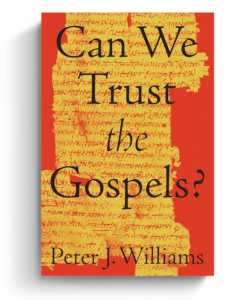 In an age of faith deconstruction and skepticism about the Bible’s authority, it’s common to hear claims that the Gospels are unreliable propaganda. And if the Gospels are shown to be historically unreliable, the whole foundation of Christianity begins to crumble.